More VIENNA WALTZES


Here are some photos of the most recent cast of Balanchine’s Vienna Waltzes that debuted at New York City Ballet last week. Top photo is of the radiant Sara Mearns, who had the main role in the final part of the ballet – “Der Rosenkavalier” – as the girl sweetly lost in her dreams during a moment alone in the ballroom. Bottom photo is of fairy-tale princely Tyler Angle dancing with Teresa Reichlen, from the first part of the ballet, the two young lovers waltz-frolicking in the woods. Both photos are by Paul Kolnik.


NYCB Spring Gala with SEVEN DEADLY SINS Premiere

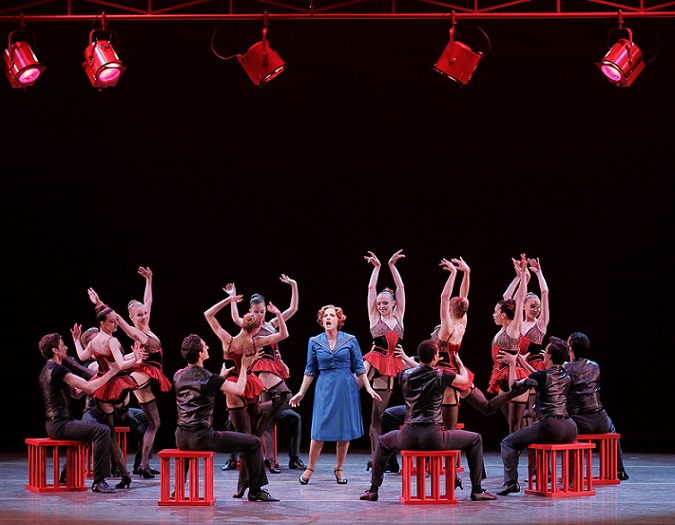
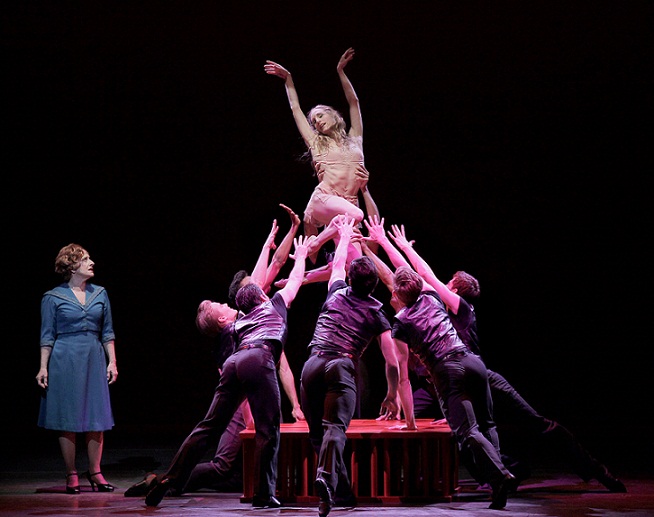
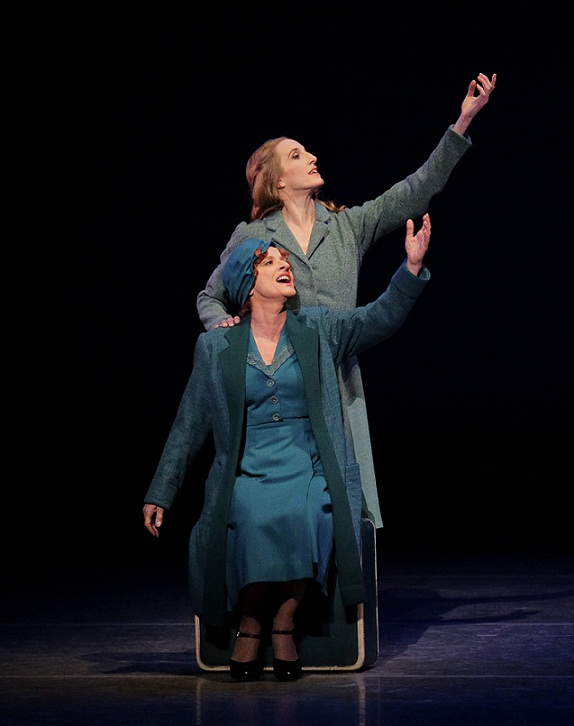
Here are some photos, all by Paul Kolnik, of Lynne Taylor-Corbett’s play-ballet, The Seven Deadly Sins, which premiered last night at New York City Ballet’s Spring gala performance. Above is Patti LuPone, who guest-starred with the company (performing the singing role of course!) and Wendy Whelan, who danced the lead. The top photo is from the “Prologue” of the play-ballet (or ballet chante as the program calls it).

This is from the second part: “Pride”: Patti LuPone and cabaret dancer ensemble.

Also from “Pride.” Wendy Whelan is in the middle.

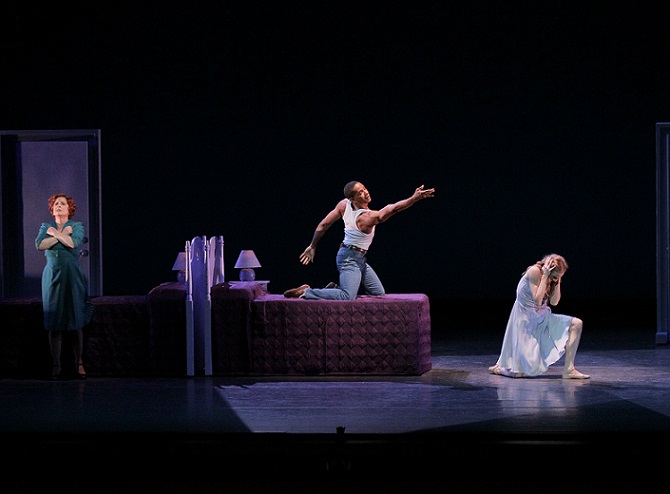
And this is from sixth part, “Lust,” probably my favorite over all. Craig Hall and Wendy Whelan are the dancers in the photo. Craig Hall and Sara Mearns (who danced the role of “Latina Diva” in the “Anger” section, and who I don’t have a picture of unfortunately), most stood out to me, as well as Vincent Paradiso as the Count in the “Greed” section. I think those dancers most stood out – at least Mearns and Paradiso – because they seem to have some kind of acting training. Maybe they don’t, maybe they’re just natural actor-types, but the more actor-ly you are, I think the easier this kind of role would be. Wendy Whelan said in an interview with Roslyn Sulcas in the New York Times that she was used to expressing herself with her body and her lines, that she was used to Balanchine’s dictum “don’t act, don’t think, just dance,” and that she found this kind of role challenging. As much of a NYCB star as she is, and as stunning as she is in Wheeldon and Balanchine’s more modern, angular-lined ballets, I just wonder if she was mis-cast for something like this.

Which isn’t to say that she didn’t dance very well last night. She danced a really beautiful pas de deux with Craig Hall, which is what made “Lust” my favorite section. And LuPone sang in a gorgeously powerful voice. The dancing was all superb. But something just didn’t work to me.

Balanchine choreographed the original Seven Deadly Sins, set to libretto and score by Bertolt Brecht and Kurt Weill, in 1933. The Balanchine version was revived in 1958. According to the Times article linked to above, both the original version and revivals received very good reviews. Since the Balanchine version appears to be largely lost now, and Peter Martins wanted to revive the ballet, he commissioned new choreography from Taylor-Corbett.

Maybe it was that the new choreography didn’t really express the story, which follows Anna, a woman whose various life experiences each represent one of the sins. It wasn’t really a full story, but one composed of scenes, each of which dramatized a sin (and LuPone and Whelan portray different aspects of Anna). But, I didn’t feel the scenes always worked well at doing that. For example, in my favorite section, “Lust,” I thought the Hall/Whelan bedroom scene was really beautiful, very romantic, but nothing said lust, as in sinful lust, to me. I almost felt like Whelan’s Anna had a loveless relationship with her husband, danced by Allen Peiffer, and she was really in love with Hall, and her leaving her husband and running into Hall’s arms was an urgently needed escape.

In my other favorite section, “Anger,” Sara Mearns is a kind of sexy, but rather humorously so, Copacabana dancer. She gets angry at Whelan’s Anna for something – I’m not quite sure what – maybe Anna stole her lover or took over Mearns’ role as head diva, drawing too much attention to herself…  Anyway, Mearns twists her face into a look of utter anger, then points at Whelan, who runs off crying and is then stripped down to her underwear by a group of men. But I thought it was done rather cartoonishly. So it was more funny and cute to me than a dramatic representation of the tragic consequences of anger.

In the “Greed” section, a count and a senator vie for something and end up in a duel, both of them getting killed. But it didn’t have any tragedy or pathos to me. Instead, it felt a bit like Balanchine’s Slaughter on Tenth, which made me want to giggle – probably the fact that it was Paradiso playing the role of the Count.

I don’t know. I guess I was expecting something with more tragedy and pathos and weight, and I felt like I saw a version of Slaughter on Tenth but without a through story-line. Maybe that was the intent. I’m going to see it again over the weekend, and maybe my opinion will change.

Did anyone else see it yet? I’m interested to hear what others think. Has anyone seen the Balanchine version?

After intermission,

— here’s my photo of the promenade – Balanchine’s Vienna Waltzes was performed beautifully.

Photo by Paul Kolnik.

All of the dancers were very good, but I particularly liked Megan Fairchild and Joaquin DeLuz in the fast-footed, playful scene in the forest, “Fruhlingsstimmen,” and Maria Kowroski and Charles Askegard in the last, beautifully ballroom-y section, “Der Rosenkavalier.”

For the Love of Duke


On Friday night Susan Stroman’s For the Love of Duke premiered at NYCB. Photos above by Paul Kolnik. Top: Tiler Peck, Sara Mearns, and Amar Ramasar; bottom: Mearns and Ramasar. Stroman is primarily a Broadway choreographer (I think her most famous work is probably Contact), and it shows both in her ballets’ strengths and limitations.

For the Love of Duke is divided into two parts. In the first, entitled “Frankie and Johnny … and Rose,” Tiler Peck and Amar Ramasar are Johnny and Rose, a couple in love. They perform a lovely lyrical pas de deux. Then along struts Sara Mearns – Frankie – and Johnny’s attentions are completely lost on her, to the disappointment of Rose. Johnny and Rose are snuggling on a bench together, and when Frankie comes prancing along, Johnny pushes Rose right off the bench, behind it, as if to hide her. Then he does a snazzier dance with Mearns / Frankie, she disappears, and he’s back with Rose … until Frankie comes strutting along again. And so on. At one point, Rose becomes the seductress, and Johnny pushes Frankie off the back of the bench. It was cute, and everyone danced spectacularly, but it got a bit old to me after a while.

The second part – “Blossom Got Kissed” – Stroman had actually choreographed before, creating it for NYCB in 1999. I liked this one better. Both parts, by the way, are choreographed to Duke Ellington and Billy Strayhorn, which is where the title of the whole comes from. Anyway, “Blossom” begins with a bunch of girls all dressed in sassy, jazzy red sitting on a bench tapping their feet to Ellington’s rhythm. Along comes Savannah Lowery as Blossom, dressed in a frilly ballet tutu. She sits alongside them on the bench and tries to tap with them. But she has no rhythm and is horribly off. Then they stand and do a jazzy dance, and, again, she tries to join, but just can’t get the hang of it. She is simply too classical ballet. Lowery was hilarious though and it was funny to see her continually try to get the rhythm and technique of jazz dance right by taking a foot and pounding it down flat on the floor. Then, a group of tux-clad men come along and do some swing dancing with the red-clad women. Blossom again tries hard to fit in but just can’t. Finally, a musician in the band (which was onstage), in the person of Robert Fairchild, comes out from the back of the stage, orders the music changed, and does a sweet lyrical ballet pas de deux with her.

I feel like I’ve seen “Blossom” before because Lowery’s hilarious flat-footedness looked familiar. I liked it better than the first part because to me it was funnier, and the story went a little further.

I think Stroman is very good at creating a story through dance, and that’s what I like about her. You can tell she’s not really a ballet choreographer though. Compared to the first two pieces of the night – Ratmansky’s Concerto DSCH and Wheeldon’s Polyphonia – the actual dance just wasn’t that rich. Still, I think she complemented the program well. It can never hurt to include in an evening of ballet a cute narrative dance with music that’s not usual ballet fare.

As always, I loved Concerto DSCH. Ratmansky was in the audience. I felt the music was played a bit too fast though (conductor was Ryan McAdams, Elaine Chelton the pianist). It looked like Ashley Bouder had a slight mishap, though I’m not sure because I was busy watching Joaquin DeLuz do a sequence of crazy fast steps into a somersault at the speed of light. Andrew Veyette again replaced Gonzalo Garcia, who I am really missing. I hope he’s okay. Veyette is doing a fine job as one of the two playful guys in blue, but there’s this repeating series of throws – where they each kind of propel the other into the air, and I love how Garcia always gets such height when he bounces off the other two.

Tyler Angle replaced Benjamin Millepied, and did wonderfully. I always notice things with Tyler that I haven’t noticed before – like how when he and the girl in green (Wendy Whelan) make their entrance, he’s spinning her around and around, and she looks like she’s hanging on to him for dear life. It kind of sets the tone of their relationship. I always notice the music much more when he dances as well.

Christopher Wheeldon’s Polyphonia is definitely one of my favorites of his. I love the musicality of it, and the originality of the combinations. It’s set to ten piano pieces by Ligeti, who, the program notes, developed micropolyphony – a type of music involving sustained dissonant chords that shift slowly over time. You can really see that “micropolyphony” in the dancing, as the sets of dancers (eight all together, divided into four pairs) begin dancing together in a line but each pair doing something completely different. Then, they eventually come together and dance in unison, but then they drift apart again later. There’s some very clever, almost humorous partnering throughout, but particularly in the second movement, Arc-en-ciel, Etudes pour piano, danced by Maria Kowroski and Jared Angle. I haven’t seen this ballet as often as I would like to. I was going to say I wish he’d include this one more often in Morphoses programs, and then I remembered

More Revivals at Alvin Ailey – THE PRODIGAL PRINCE is Electrifying!


Last night was, sadly, my last Alvin Ailey performance of the season. They performed two revivals – Geoffrey Holder’s The Prodigal Prince from 1968 (which was astounding), and Judith Jamison’s Forgotten Time, from 1989. They also performed Christopher Huggins’ new Anointed, which I saw earlier in the season and wrote about here.  (Photo above, by Paul Kolnik, is of Samuel Lee Roberts in Prodigal Prince).

I liked Jamison’s Forgotten Time. As you can see in the photos below, she created some very beautiful images with the partnering. Photos below are by Paul Kolnik. In the first and last, the dancers are Jamar Roberts and Antonio Douthit; in the middle two, they are Linda Celeste Sims and Clifton Brown.


It was very spiritual and I loved the ending image, with the ensemble of dancers – about 13 in total – all looking up and waving their arms back and forth. At many points the dancers would look up toward the sky, into the light, as if searching for something, some spiritual being. At points the men would lift the women on their shoulders so they could gaze even higher. And there was as stunning solo between the two main men in the middle. Last night that solo was performed by Glenn Allen Sims and Jermaine Terry, who were very good. The audience gave them huge applause at the end.

The music was hauntingly beautiful. It was by Le Mystere des Voix Bulgares, and sounded like Bulgarian spirituals. I also loved the costumes (by Jamison and Ellen Mahlke).

I really loved The Prodigal Prince, as did the whole audience. I didn’t know when we were going to get out of there after the performance was over, the dancers received so many curtain calls. By Geoffrey Holder (who’s won Tony awards for The Wiz and Timbuktu), from 1968, the company revived it this season. I think they should do it every season though. It’s a good dance to end the evening with, so they could alternate more often between it and Revelations.

The subject of The Prodigal Prince is Haitian painter Hector Hyppolite (see some of his images here). According to the program notes, Hyppolite was also a houngan – a high priest of Voudoun, the religion of the Haitians. In 1943 St. John the Baptist and the Voudoun Goddess Erzulie came to him in a vision which inspired him to take a sojourn to Africa (which he may have imagined) and paint the Voudoun loas – or African gods. His paintings became celebrated after leading surrealist Andre Breton discovered them and brought them to Europe.

Most of the choreography consists of Haitian and African dance; I’d never seen Haitian before and I found it spellbinding. It’s amazing all that the Ailey dancers can do, and do superbly. The music, also by Holder, was very drum-heavy, very rhythmic, very African – the type of music that makes you want to take up African dance. Samuel Lee Roberts’ depiction of Hyppolite, as he encountered Erzulie (danced by Akua Noni Parker) and Saint John the Baptist (in African form, danced by Jamar Roberts), then dreamed of Africa and was taken with the African spirit (danced by Michael Francis McBride), was excellent. Samuel Lee Roberts is so good at roles that require the dancer to act as well as dance. Earlier in the season, he danced the role of Lazarus in Mary Lou’s Mass and he was the highlight of that entire dance. He’s very entertaining and can bring out the humor in a story without reducing its depth.

The whole dance was so mesmerizing, the costumes brilliant, and the beat of that music so infectious. Definitely one of the highlights of the season. Here are more pictures, all by Paul Kolnik.


(Lee with Briana Reed as Erzulie.)


All photos from AlvinAiley.org.

The company still has about two weeks left of their City Center season. Go here for the schedule.

Alvin Ailey: New Dances and New Productions

Alvin Ailey season is upon us! I attended two performances over the weekend and, of course, they made my weekend. I’m always so happy when I come out of an Alvin Ailey performance. Particularly with their new, 50-dancer Revelations, which I think is only for this year because it marks the dance’s 50th year anniversary. I’ve always thought of this dance as the quintessential American dance, and it’s so stunning seeing the stage completely filled with dancers. For some of the solo sections like “I Wanna Be Ready,” they triple up the number of dancers, and they often use students from the Alvin Ailey School and from the Ailey II company for the larger sections like “Pilgrim of Sorrow” and the “Honor Processional” from “Take Me To the Water.” So, please, if you’re in New York, try to see one of the 50-dancer versions. They’re only showing that production of Revelations on certain dates, so make sure you check the City Center schedule. I hope they consider doing this a few times a season in the future, though, because (expensive as it probably is) it’s really so brilliant.

Also, my new second favorite dance is now Cry. I’ve seen it twice this season, and don’t really know now if I’ve ever seen the whole thing. Maybe I’ve only seen Judith Jamison dance it on video and I’ve seen the individual sections before onstage, never in whole. It was created by Mr. Ailey in 1970 but this is a new production. This year they have three different dancers dancing the three solos. The first solo is set to Alice Coltrane’s “Something About John Coltrane,” and was danced the nights I saw it by Linda Celeste Sims on the first night, and Rachel McLaren on the second. They were equally spellbinding. This section, to me, is very powerful, the movement is very modern, with lots of sharp staccato movements meant to convey strife and longing and fear and a whole host of emotions – along with clever, ironic uses of a towel-like sheet – and it requires very powerful dancers.

The second section, the adagio set to Laura Nyro’s “Been on a Train,” which often nearly brings me to tears, was danced both nights by Constance Stamatiou, who is really growing on me this season. She’s a really beautiful, very “womanly” dancer, and she is really growing to have a great stage presence.

The third section, the more rhythmic African section, set to the Voices of East Harlem’s “Right On, Be Free,” was danced both nights by Briana Reed, who’s always been one of my favorite dancers in the company. She was out of most last season and I’m so glad she’s back. Mr. Ailey dedicated this dance to “all Black women everywhere – especially our mothers.” I love how it begins with a powerful evocation of oppression and ends with a celebration of African roots. I hope they perform it every season.

The two new dances I’ve seen so far (there are many to come in the next few weeks), are Christopher Huggins’s Anoited (which is a world premiere this season), and incoming artistic director Robert Battle’s The Hunt (which is new for Alvin Ailey this season).

The Hunt is great fun! I loved it. I could see that one every night, just like Revelations. All six dancers are men and it depicts, as the name implies, the rituals involved in preparation for a hunt. It conveys how physically and mentally grueling the hunt will be as a test the men’s limits, and it also showcases the athletic power of Ailey’s male dancers. And the music is mad fun! It’s Les Tamours du Bronx, wildly percussive, so much fun! I joked on Twitter that I needed to get it for a workout tape. Seriously!

It’s certainly a male moment in dance! This dance received loads of applause and a full-audience standing ovation. In Revelations, which followed, “Sinner Man” then received huge whoops and hollers from the crowd. As they should have. But the women of Cry deserved a full-audience standing ovation too! Not fair!

Christopher Huggins’s Anoited is really beautiful. Huggins is a former member of Ailey and this dance is a tribute to the leaders of the company, both past and present. The first section is a really lovely duet by Jamar Roberts and Linda Celeste Sims, with the two meant to depict Alvin Ailey and Judith Jamison.

Over the music we hear Jamison’s words to Ailey, when he told her he was sick and asked her whether she would take over the company. “And I said, ‘Of course!'” she repeats many times. At the end of the duet, he lies down, and she sadly kneels over his body. These two dancers are perfect to represent Ailey and Jamison. If this company does have a “star” right now it’s Linda Celeste Sims, and Jamar Roberts, with his physicality and stage presence is larger than life.

In the second section, set to more percussive music by Sean Clements, Jamison is joined by four other women known for keeping Ailey’s legacy alive over time: Sylvia Waters (director of Ailey II), Denise Jefferson (director of the Ailey School, who recently passed away), Nasha Thomas Schmitt (director of Ailey’s arts in education program), and Ana Maria Forsythe (director of the Ailey / Fordham BFA program). The women are all dressed in celebratory purple and they dance a rhythmic, high-charged African / modern combo.

In the third and final section, entitled “52 and Counting,” the dancers all come together and are joined by others, all dressed in red. They dance to a fast-paced beat, sometimes in ensemble, and breaking into duets replete with thrilling lifts. It reminded me a bit of the second section of Love Stories, or of Tharp’s The Golden Section and it stood for me as a celebration of some of the more contemporary pieces the company is known for. Amidst all this, the figures of Alvin Ailey and Judith Jamison return, and perform another beautiful lift-heavy duet, this time with Roberts dressed in white.

I’ll write more as the season continues. As I said there are many more premieres to come (check out City Center’s website for the schedule). For now, I’m off to a Nutcracker by the Royal Ballet. I love the diversity of dance 🙂

All photos from AlvinAiley.org. Top photo by Christopher Duggan; all other photos by Paul Kolnik.

More Photos of Millepied’s “Plainspoken”

Here are a couple more photos of Benjamin Millepied’s Plainspoken, which premiered last week at New York City Ballet and which I wrote about here.  Top is, from left: Amar Ramasar, Sterling Hyltin and Tyler Angle; below, from left: Jennie Somogyi, Amar Ramasar, Sterling Hyltin, Tyler Angle, and Jared Angle. Both photos by Paul Kolnik.


NYCB Brings Back “The Magic Flute” and Ashley Bouder Astounds in “Serenade”

On Thursday evening, New York City Ballet performed for the first time since 1982 Peter Martins’s The Magic Flute (pictured below – both photos by Paul Kolnik). But first on was Balanchine’s Serenade, with Rebecca Krohn (in the photo at left, the ballerina the farthest left) debuting in the role of the “angel.” Jenifer Ringer (center) was the “lost girl,” and Ashley Bouder (on the right) the dancer who dominates the first section.

Every time I see this ballet I see something new and though she wasn’t debuting in the role, this was my first time seeing Ashley Bouder. She completely blew me away and brought to life a “character” I never really even noticed before. I use quotes because of course Balanchine insisted that this is a story-less ballet and he didn’t create any such characters, but over time viewers have come to create their own story and now, for example, everyone calls the ballerina whose actions seem to bless and save the woman who falls and seems distraught over a man, the “dark angel.” Anyway, I realized for the first time when I saw Ashley dance that her character is supposed to be the A-student, the one who can do all the astounding feats and just flies all over the stage in those jetes. I kept thinking of Natalia Osipova. Wow. That’s always been my least favorite part of the ballet – that “class section” at the beginning; I always long for the final, more poetic part when what can most be read as a story takes place, with the angel and a male figure representing to me blind justice save the tragic woman’s soul.

Anyway, for the first time I really didn’t want the first part to end. Ashley was just so spellbinding. It wasn’t just that her jetes were so stunning though; it was that she created a character who ate up the stage, but not out of competitiveness and need for attention, but simply because she was so good she couldn’t help it. That’s what her dancing conveyed to me anyway, and then I couldn’t take my eyes off her.

Rebecca Krohn did very well in her debut as the angel. Only thing was that she was so much shorter than tall Ask la Cour (in photo above) that when followed him from behind with her hands wrapped around his eyes, she really had to stretch.

Jonathan Stafford also made his debut in this ballet, as the “distraught girl’s boyfriend,” if you want to call him that. I thought he danced very well, but I think I personally prefer Charles Askegard in this role because I see that man as tantalizing her, tormenting her, and responsible for her downfall, and there is just something innately cocky about Askegard. Jonathan Stafford is too sweet 🙂

Okay, so The Magic Flute. NYCB as I said hasn’t performed this in a while and it’s kind of obvious why: it just doesn’t seem to fit at all in their repertoire. It was a short story ballet filled with slapstick and cutesy characters. It was danced very well – and Megan Fairchild and Andrew Veyette are two of the company’s best actors and they did in my mind as much as could possibly be done it. Everyone did well, actually, and it seems the dancers enjoyed the opportunity to do something they never get a chance to.

The story bears no relation whatsoever to the Mozart opera. It’s the story of a farm girl (Megan) who likes a peasant boy (Andrew) but she is betrothed to this incredibly hilariously dorky older man, the town’s Marquis (played well by Adam Hendrickson).This is where most of the slaptick comes in – in trying to seduce them the Marquis falls all over the village women, goes to kiss Megan’s hand but ends up with Andrew’s, literally falls all over poor Megan, etc. etc. Eventually, a strange hooded character indicates to the peasant boy that everything will be all right, he will get the girl, but he must watch for something to fall from the sky. That something is a flute, which comes bearing a huge sign for all the audience to see: “If you play this flute, people will dance against their will.” Audience cracked up at this of course.

So, Andrew grabbed the flute and tried it out on his friends, realizing it works! I have to say Andrew’s flute playing was very believable. Of course the flutist is in the orchestra pit but damn did it look like Andrew was making that music!

So, now every time the Marquis tried to grab Andrew and toss him off Megan, Andrew would starting playing the flute and the Marquis would start hopping around like a madman. Angry at his lack of control, he pulls his men on peasant boy, eventually tries to get the court involved, and soon everyone is madly hopping about. There’s no choreography for the uncontrollable dancing – everyone just hops about punching the air at random. Eventually everything works itself out and Andrew and Megan end up happily together.

The costumes were cute and the sets were very well done (it was suggested at intermission that ABT might want to hire set designer David Mitchell for their productions), I’m just not sure this ballet really belongs at NYCB. But it’s nice for a change.

The program ended with Balanchine’s patriotic Stars and Stripes set to Sousa. Savannah Lowery had the lead in the second section – the “second campaign” – and she fell during her stage entrance. It looked like just a slip but then she didn’t dance her part full out at all – jetes were very low and she looked very concerned going on pointe. It soon became clear she’d really hurt herself when she didn’t return for her solo seconds later. The company didn’t have time to replace her with another ballerina right then, so the corps members just kind of looked on and sweetly smiled as they stood still during what should have been Lowery’s solo. It was kind of like that experimental Jerome Bel film where the camera focuses solely on the corps members while the Swan Lake music swells.

Anyway, by the end, after the fourth campaign when all campaigns return, she’d been replaced by trooper Gwyneth Muller, who my companion noticed seemed not to have much makeup on. There probably aren’t too many emergencies like this where a dancer who thinks she’s done for the night (she’s played Megan’s mother in The Magic Flute) but hasn’t yet left the building has to get in costume and run back out onstage for a main solo! Anyway, she did well. I hope Savannah’s okay though.

Janie Taylor Debuts in Millepied’s “Why Am I Not Where You Are” Etc.

I’ve been remiss in my New York City Ballet posts! Last week I saw two programs: one featuring three dances to three different violin concertos – Peter Martins’s Barber Violin Concerto, Robbins’ Opus 19 / The Dreamer, and Balanchine’s Stravinsky Violin Concerto. And the other program was another in the “See the Music” series but was also dedicated to Santiago Calatrava, who designed sets for all three of the ballets performed – Benjamin Millepied’s Why Am I Not Where You Are (pictured above, photo by Paul Kolnik), Christopher Wheeldon’s Estancia (pictured below, photo also by Kolnik), and Mauro Bigonzetti’s Luce Nascosta, all of which premiered last season and which I wrote about here, here, and here.

Calatrava was in the theater, and after encouragement by Peter Martins, he rose and took a bow.

Then, as with the first “See the Music” program, before the performance began, the orchestra pit rose and conductor Faycal Karoui gave a humorous little explanation of various parts of the Thierry Escaich score from Millepied’s Why, the first ballet performed.

These explanations are really interesting to me, I have to say. I only took one classical music class in college and now wish I’d taken more. Karoui talked about how there were four main parts to the score: a waltz, a tango, a disco, and a final climactic part, and he talked about the differences in tempo between them, and between them and a typical waltz, tango, etc.. He also talked about how the ballet has a central male character (danced very well by Sean Suozzi – in top picture, being carried by the group of men), and how you can hear that central character’s theme – or voice – throughout each section of the music. But the voice changes with each section: at first, he’s shy and mysterious (and his voice in the first section is portrayed by a violin solo), then as the orchestra grows sharper and stronger in the second, tango, section, so did the character, etc.

When we got to the “disco” section (it sounded nothing like disco to me but just slightly more mechanical and percussive than the preceding sections), Karoui really began rocking out as he led the orchestra. It was like he was actually dancing in a disco, and I nearly cracked up. I’m not sure if that’s what he normally does down in that pit – if he regularly starts to embody the music literally like that, or if he was just being a goof for the audience. He didn’t seem to be hamming it up at that point, though – oddly – so who knows. Anyway, he is very entertaining and I find his musical explanations very educational as well. What more can you ask than to be both entertained and educated, right?

Anyway, Janie Taylor debuted in the Millepied. She was supposed to have debuted when the ballet did last season but she was out with injury and so Kathryn Morgan had filled in. Character-wise I thought she played it the same as Morgan. Except with Morgan it seemed to have a West Side Story feel to it; with Janie it was darker and more La Valse-like. Both were tragic, but in a different way; Kathryn’s character seemed more innocent. Anyway, this was my second time seeing the ballet and it grew on me. It’s very dramatic, not a dull moment in the whole thing, and you’re really on the edge of your seat, both because of the intensity of the music – maintained throughout each section – and the dramatic story of the poor innocent guy who’s drawn into another world by his enchantment by this ethereal creature, only to get trapped and ultimately destroyed, along with her.

To me, Sara Mearns and Amar Ramasar, with their bravura roles, largely stole the show – I think I remember thinking the same last time. She with those crazy fast chaine turns all around stage that almost make you sickly dizzy, and he with his virtuosic leap sequence – they are kind of the sinister characters, seducing Suozzi but also the audience.

Then came Estancia, and it was my first time seeing Ana Sophia Scheller and Adrian Danchig-Waring (pictured above) in the leads. I’m not a huge fan of this ballet – well, I like the ensemble sections, particularly the dancing and taming of the “horses” – but I nearly fall asleep during the middle, romance part, where city boy wins country girl over. I think it’s just the choreography in that middle section (that I found relatively bland) that slows it down – along with the music – but I liked Scheller and Danchig-Waring just as much as the first pair of leads – Tiler Peck and Tyler Angle. In fact, they seemed to fit the roles a bit more. Scheller reminded me of the main character of Agnes de Mille’s Rodeo and there was something more sweetly, playfully tomboyish about her look than Peck’s. And Danchig-Waring perfectly suited the city boy trying to woo her. He acted his part very well. And his movement is always very sharp. Andrew Veyette and Georgina Pazcoquin as the horses who are eventually tamed, were fabulously entertaining.

And lastly was Bigonzetti’s Luce Nascosta (picture at left by Kolnik), which I’ve seen now three times and which I like but think is too long. I missed seeing Craig Hall in the middle section that seems to be softer and looser than the other sections, where the movement is more marked by those extreme shapes with the flexed hands, splayed fingers, and angular balances and slides on pointe. Hall seems to have the ability to move in a more undulating, kind of serpentine way than most of the others and it seems to me to suit that middle section well.

In the previous program, I loved Megan Fairchild again as the “modern” dancer in Barber Violin Concerto, and, as always, Gonzalo Garcia as “the dreamer” in Robbins’ Opus 19!

New York City Ballet’s First Fall Season Opening Night


Tuesday night, New York City Ballet opened its very first fall season with performances of Balanchine’s Serenade, Peter Martins’s Grazioso, and Jerome Robbins’s The Four Seasons. First, before the performance began, Peter Martins came out and introduced each of the principal dancers, who came out onstage one by one, and said this season would be a celebration of them. Tiler Peck in particular was wearing this really gorgeous silky fuchsia dress. Martins said all principals were there except for Benjamin Millepied, who was doing something movie-related “en France,” he said with a funny faux Euro accent. Everyone laughed and gave the dancers a huge round of applause. The house was packed and it was clear how thrilled the company’s many fans are with there being a fall season this year. Martins made fun of himself for being so into toasts and said that during intermission, we’d all be given be given free champagne to toast the principals. Which we were – very fun!

The part of the performance I was mainly looking forward to was Janie Taylor’s debut in Serenade (above headshot and Serenade photo by Paul Kolnik) as the main ballerina. As usual with her, she completely made the ballet her own. I thought the ballet had a somewhat dark element with her, that I’ve never seen before. When she first ran out onstage, late for class, instead of looking like she was all frantic about being late because she’d been held up by a boy, it looked like she was running from something – from him. That man was Charles Askegard and when he danced the middle waltz part with her, the huge size difference between them added to the sense of foreboding, that she was fragile, he was pushing her around, and she’d eventually be hurt by him. At certain parts, it was literally like he was pulling her along. When he lifted her and she raised her legs in a split, it looked almost like she was trying to get away from him. Sara Mearns was the angel and Ask La Cour was the man who I call “blind justice” who take care of Taylor when she falls, and it was interesting how much the two male leads and two female leads looked alike. I almost got Taylor and Mearns mixed up at parts, thinking they were taking on the other’s role. And the end when the men raise Taylor up like pallbearers and she is carried off by them, arching her back, arms outstretched  – so hauntingly beautiful. It reminded me a bit of Balanchine’s La Valse.

I was also looking forward to Martins’s Grazioso, in which three handsome men – Gonzalo Garcia, Andrew Veyette and Daniel Ulbrich – vie for Ashley Bouder’s attention with their bravura moves. I don’t think this ballet has been performed since it premiered a few seasons ago. And I loved it all over again. I love how each guy has his own personality – Garcia is the romantic, Veyette is the manly man one, and Ulbrich is the one with all the high jumping tricks. And Bouder really played the tart, looking at each of them up and down at points kind of lasciviously, really trying to choose. The guy next to me was really giggly over it.

And the evening ended with Robbins’ The Four Seasons, which itself ends with a lovely tribute to fall.

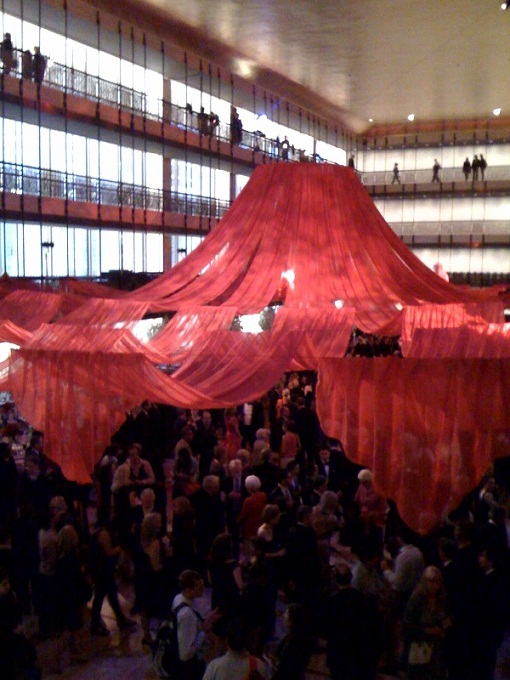
This whole season the Koch theater will open an hour early. The promenade overlooking Lincoln Center Plaza will be open for cocktails, the gift shop will be open, and, for the rest of this opening week, there will also be live jazz performed by the NYCB Orchestra one hour before performance time. They have the promenade and mezzanine area done up nicely, with big plush chairs. Also taking place the rest of this week will be a “meet the artists” session whereby, beginning at 6:45 p.m. in the first ring of the auditorium, the principals dancers will be available to chat with ticket holders. There’s also a photo exhibition of the dancers by photographer HenryLeutwyler on display in the theater throughout the season.

Tomorrow night will be the first of seven “See the Music” performances which will provide a look inside NYCB’s 62-piece orchestra. At the beginning of each performance, Peter Martins and musical director Faycal Karoui will briefly discuss the program’s music, followed by the orchestra performing an excerpt of one of the ballet scores. The subject of tomorrow night’s discussion will be Eduoard Lalo’s score for Ratmansky’s Namouna: A Grand Divertissement, which premiered last season. Additional “See the Music” programs are Sept. 26 matinee, January 20, Feb. 1, Feb. 19 matinee, May 25 and June 11.

AN ERA ENDS: DARCI KISTLER GIVES HER LAST PERFORMANCE WITH NYCB


Yesterday afternoon marked the end of an era as Darci Kistler, the last dancer to be hired, trained, and made into a star by George Balanchine, gave her last performance with New York City Ballet, where she’s danced for the past 30 years. Kistler, originally from Riverside, California, began studying at Balanchine’s School of American Ballet in 1976, was hired to dance with the company in 1980, and was made into a principal in 1982, at 17 years of age. She remains the youngest principal ever at NYCB.

It was a huge event, needless to say — practically every critic and blogger was there, longtime donor patrons were greeting each other right and left (and there was a party for them afterward). The house was completely packed, and the plaza was filled with people asking if anyone had a ticket for sale.

The program consisted of Balanchine’s Monumentum Pro Gesualdo and Movements for Piano and Orchestra, the Titania / Bottom pas de deux from his Midsummer Night’s Dream, his Danses Concertantes, and the beautiful final act of Peter Martins’s Swan Lake (which almost made me cry, and I don’t think I’m the only one).


Monumentum Pro Gesualdo and Movements for Piano and Orchestra is an abstract leotard ballet in two parts that Balanchine set to Stravinsky. I always prefer the second part, which its flirtatiousness, its angular lines and sharp shapes, to the more lyrical first part. Darci danced that second part with Sebastien Marcovici, and the first part with Charles Askegard. I’d only ever seen Maria Kowroski in the female lead in this ballet and it was interesting seeing another body in the role. Kistler danced it more smoothly lyrical and her edges were more rounded, but she played it up really well, really “acted” it, like she was really responding to Marcovici’s movement and he to hers, as if they were in conversation.

That Titania / Bottom pas de deux is one of my favorite parts of Balanchine’s Midsummer Night and I’m glad she chose it. She was sweetly hilarious as she fell head over heels for Henry Seth’s ‘donkey persona’ after both had spells cast on them by the mischievous Puck.

Danses Concertantes was the only ballet she didn’t dance; it was danced well by Megan Fairchild and Andrew Veyette.


And the program ended with the last act of Martins’s version of Swan Lake. The Martins is one of the only versions of this ballet I know of that doesn’t have some kind of happy ending, and it was really fitting here, this being the most bittersweet of farewells. In Martins’s version, Odette and Prince Siegfried can’t be together because he has been unfaithful to her with Odile. So the ballet ends with her bourreing backward, away from his outstretched arms, into her flock of swans, who envelop her. Jared Angle’s Siegfried continues reaching out toward her, in sorrowful outstretched lunges, but he’s unable to reclaim her. She literally retreats into the wings, and metaphorically returns to her ethereal, otherworldly place. So poetic, and so fitting for a prima ballerina retirement. And so sad…


All photos by Paul Kolnik. (Bottom photo I scanned from an earlier program)

MAURICE KAPLOW’S FAREWELL PERFORMANCE WITH NYCB


Thursday evening longtime New York City Ballet principal conductor Maurice Kaplow gave his final performance with the company. I had never been to a conductor’s farewell before, and, of course, part of what made this extra sensational was that the newishly mobile orchestra pit (photo above) was raised to stage level for part of the program.

There were four pieces in the program: Melissa Barak’s recently premiered Call Me Ben (the only piece Kaplow didn’t conduct), which was followed by Euryanthe, the Barber Violin Concerto, and ending with Western Symphony.

Euryanthe was only an orchestral piece – no dancing, by Carl Maria von Weber. When Kaplow first took the podium, everyone cheered, which grew into a standing ovation as the orchestra pit rose. One thing I didn’t realize (we’ve only seen the pit rise once before, during the first NYCB program following the Koch theater’s renovations last year) was that the conductor can’t stand at the podium while the pit is rising and falling; he must step down into the musicians’ area. When the pit was finally level with the stage and he climbed up to the podium, he looked out toward the applauding audience and took a grateful bow. Euryanthe was really beautiful, with a lovely, almost sentimental (given the occasion) violin section, followed by an exciting drum-heavy climax. It was nice to see the orchestra for once, and to be able to focus on the music.

Peter Martins’s Barber Violin Concerto really blew me away. I’d never seen it before, and I have to say it’s now one of my favorites of his.


Pictured from front to back: Megan Fairchild, Sara Mearns, Jared Angle, and Charles Askegard. There are two couples in this piece – one a classical ballet pair, the other a modern dance duo, and at first they dance each with their rightful partner, then the two members of the modern couple break apart and dance with the opposite sex ballet dancer. When I interviewed So You Think You Can Dance’s Billy Bell a while back, he’d laughingly said something to me I found funny, that as a hopeful choreographer he sought to “break” ballet dancers, meaning he wanted to get them to loosen up, not be so rigid and controlled with such straight, upright posture, and get them to really move. This piece reminded me of that. At first Sara Mearns’s classical ballerina in pretty satin pointe shoes wants nothing to do with this crazed barefoot Jared Angle, but eventually she realizes he’s not so bad and they do a quite nice pas de deux together.

Same with Megan Fairchild and Charles Askegard, except choreographically they were more fun, and Megan totally blew me away and made me think she is really a modern dancer. She was the most compelling person onstage and I couldn’t take my eyes off her, despite the fact that one of my big favorites, Sara Mearns, was up there with her. Megan looked like a real Paul Taylor dancer but even more stunning. Her character really taunted Charles Askegard’s classical danseur, jumping on his back, wrapping her flexed feet around his middle, darting in between his legs, really kind of climbing all over him. He looked tormented, then eventually relented and they danced a pas de deux together too. Interestingly, people giggled throughout this part – where Megan’s modern girl is taunting Charles’s classical man –  and the critic next to me who’d seen the ballet many times before said he’s never heard people laugh at that section, that he didn’t think it was supposed to be amusing but more raw. Maybe it was because of their size difference — Charles Askegard is the tallest dancer in the company (I think he’s 6’4) and Megan’s this tiny little thing who looks rather doll-like. I found it cute and flirtatious and now I don’t think I’d like it if I saw it done more raw, though I’d love to see other dancers do it. I’d love to see this ballet again.

Also, as the title of the piece would imply, there’s a really beautiful violin solo (played by Arturo Delmoni), where the violin almost sounds like a human voice.

Last on was Balanchine’s Western Symphony. Andrew Veyette danced the male “Rondo” role and after seeing Robert Fairchild in this role last week I thought I’d never be able to see another dancer do that part. But, whoa, Veyette completely floored me. He was on fire as he kicked his heels up high in the air, sexily do-se-doed toward Teresa Reichlen (who was stunning as well as the female lead in that section), then whipped her off into the wings where he pretend kissed her. She’ taller than he is and at first I thought they weren’t a good match, but they kind of played up their height differences. I loved it.

As usual during the curtain call, the maestro came out onstage and took a bow. But of course this time he didn’t merely motion down toward the orchestra, directing the applause at them, but took the stage alone, and, like the retiring dancers, was greeted by a row of dancers bearing bouquets. Eventually, the entire orchestra came up bearing flowers as well. Peter Martins came out onstage and hugged him. Very sweet. Then, Martins led the orchestra (joined by the audience) in singing “Happy Birthday,” so apparently it was Kaplow’s birthday as well. He’s been with the company for 20 years. I’ll miss seeing him in the house.

Photos by Paul Kolnik.

MORE PHOTOS OF CALATRAVA’S AWESOME MIRAGE SET


Above are a couple more photos of Peter Martins’ new Mirage ballet, which I wrote about here, that better showcase Santiago Calatrava’s stunning architectural set. I’d described how it closed at one point, and you can see that in the bottom photo, and I’d forgotten to mention that in the end it radiated a rainbow of color (top photo). Photos are by Paul Kolnik and are taken from Marina Harss’s excellent write-up in The Faster Times.

Funny, I recently discovered The Faster Times (I know Marina but I know her as a New Yorker writer) and was really amused to see that my very first ballroom teacher (the one who’s ultimately responsible for the title of this blog) is their ballroom critic!