PASHMINA LIFTS AND LITTLE DOGS WHO STEAL SHOWS: ALEXEY MIROSHNICHENKO’S "THE LADY WITH THE LITTLE DOG"


Last night at New York City Ballet was the world premiere of a new ballet by Alexey Miroschnichenko, The Lady with the Little Dog (photo above, of Sterling Hyltin and Andrew Veyette, by Paul Kolnik). The ballet is based on the short story by Anton Chekhov of the same name (which I haven’t read but now wish I had). Miroshnichenko made the ballet in honor of the 150th anniversary of Chekhov’s birth and he dedicated it to Maya Plisetskaya in honor of her 85th birthday.

I really liked the ballet — really enjoyed the whole evening. Though I didn’t know the story, The Lady with the Little Dog was very Chekhovian, very full of angst-ridden characters (danced by Hyltin and Veyette), along to a score by Rodion Shchedrin that went along well with the drama.

It began with Sterling Hyltin dressed in a gorgeous deep purple dress with a plush velvety top and romantic tutu, walking a little dog on its leash across stage. Veyette was in the back, bespectacled, and wearing a white suit, looking like a 19th Century Russian businessman. (The splendid costumes were by Tatiana Noginova). There were also several male dancers dressed in grey bodysuits writhing around onstage. I originally thought they were a kind of chorus that would echo or foretell the action of the “play” but then they had some very dog-like movements – holding their hands up, bent at the wrists, kind of like dog paws, lying on the ground and playfully kicking their feet in the air, rolling over. But the program called them “angels.” It soon became clear that their function was to control the events — get the lady and the gentleman to meet, sleep together, then tear them apart — perhaps one of them died? — then bring them in the end together again as they walked along a path toward heavenly light.

Anyway, back to the beginning: well, as Sterling walked that little dog across the stage (I’m not good with dog breeds, but he was small and fluffy, with straight shaggy hair), he kind of initially stole the show. He kept looking out at the audience, into the darkness, but he looked intrigued, not scared. Then, Sterling would lift her leg and he’d turn and look at her like she was a bit off her nut. Then a grey guy came up and wiggled around and the dog would take a step back, then try to go around him, but the leash preventing him from getting too far. It was too much. Finally, Sterling stopped, frozen in time, and a grey man took the leash and led the dog offstage. Right before he went into the wings, he took another inquisitive look out at the audience. There were several giggles. It was too cute and I was reminded of Melanie LaPatin once saying no performer ever wants to follow an act involving children or animals.

Anyway, fortunately the dog didn’t return (although I secretly kept wanting him to). It took a few seconds for the audience to calm down and re-focus, but eventually we did. They grey people set up what looked like a long rubber mat which separated Sterling and Andrew. Each principal danced separately, then with the grey men, then the grey men eventually brought them toward each other and they danced together. The only odd thing to me was the background set (along with that rubber mat; set designs were by Philipp Dontsov). The back wall looked very abstract, which seemed kind of out of place in a period drama, although maybe it was meant to universalize the emotion. It looked to me like the middle of an airplane, with slanted airplane-like windows lining the back wall. As the action unfolded, the windows got smaller and smaller until they eventually disappeared.

Anyway, in the second movement, Hyltin and Veyette danced this really gorgeous MacMillan-esque pas de deux with lots of beautiful sweeping overhead pashmina-esque lifts — which of course I’m always a sucker for! So that was my favorite part. Then, the grey men returned and helped the two principals out of their clothing, and they danced a rather beautiful sex scene in skin-toned underwear. I have to say, as I was watching I couldn’t help but think of a similar scene from Pascal Rioult’s Views of the Fleeting World, which was so slow and serpentine and tantalizing, yet beatific. This wasn’t the same; it was a little more frantic and angst-ridden, which I guess is more Chekhovian (I will have to the read that story).

Then, the grey people direct them to get back into their clothes, and soon we see Veyette doing a kind of mad dance, eventually running across the stage and disappearing into the wings, Hyltin running after him, but unable to catch him. Then she does a rather sorrowful solo.

Eventually Veyette returns, they dance together again. But this time it’s a more mature love, not as Romeo and Juliet balcony scene as the first. Eventually, they take off their clothes again, the mat is laid vertically across stage, running front the front of the stage to the back, and the two hold hands and walk together down the path, toward the back of the stage, toward a bright, golden light. The end. I wasn’t sure if Veyette died and they were coming together again in the afterlife, or if they just had a fight and this final scene represented them kind of going off into the sunset.

Of course Miroshnichenko came out for a bow during the curtain calls — and unbelievably, though the vast majority of the audience applauded, there were a few audible boos. It’s like some people were getting opera confused with the ballet. I mean, seriously, this wasn’t a new, iconoclastic production of Tosca; it was a brand new ballet…

Anyway, I liked it and would like to see it again.

The other two ballets of the night were Balanchine’s Agon, an abstract black and white leotard ballet set to Stravinsky’s unsettling score. The choreography was really brilliant, very original, and there were lots of pretzel-shapes in the duets (the main one danced by the hyper flexible Wendy Whelan, with Albert Evans), and it made me realize where Christopher Wheeldon gets his inspiration from ๐Ÿ™‚

The evening ended with Cortege Hongrois, basically Balanchine’s wonderful one-act version of Raymonda, which I’ve been going on about after seeing ABT II perform part of it at the Guggenheim recently. Sean Suozzi danced what I’m now calling the Irlan Silva part — the virile, folksy Hungarian lead — along with Rebecca Krohn. I haven’t noticed Suozzi much before this season, but he is really standing out to me. He danced the lead in this, one of the duets in Agon, and he did a lot of dancing in Who Cares? last week. He is really good! And Maria Kowroski and Jonathan Stafford danced the balletic leads and made me badly want to see Diamonds” again.

ROBERT FAIRCHILD DEBUTS IN FANCY FREE (BUT TILER PECK GLOWS!)


Over the weekend, SLSG favorite Robert Fairchild had his debut in Robbins’ Fancy Free at New York City Ballet. This is one of my favorite short ballets: three sailors on shore-leave try to pick up women in a bar, but, there being only two women, they kind of get into a little competition, dance-off-style of course. Fairchild danced the role of the Latin guy, Tyler Angle the more head-in-the-clouds romantic one, and Daniel Ulbricht, the short Swing-y one with all the toe-to-finger splits jumps off the bar. The first woman was Georgina Pazcoguin and the one in purple who for a moment falls for the romantic one was Tiler Peck.

(photo above by Paul Kolnik, taken from Ballet.co, of, l-r Amanda Hankes, Tiler Peck, Damian Woetzel, Tyler Angle and Daniel Ulbricht)

Ah, Tiler Peck was so lovely! She dances that role so well — she really inhabits it, and when romantic guy cartwheels her over his head it just makes me swoon! I like her even better than the ABT ballerinas who dance this role – Gillian Murphy and Julie Kent. Peck brings the most to it I think — the dreamy girl who allows herself to get swept off her feet, at least until the guys get out of control. Pazcoguin and Kaitlyn Gilliland – who debuted in the ballet as well, as the third girl who comes on at the very end — did well too, although I thought Gilliland looked a slight bit unbalanced in the high heels.


(Robert Fairchild headshot by Paul Kolnik)

Ulbricht was perfect as the high-flying guy with his bag of tricks, and Tyler Angle was fine as the dreamy balletic one — the best role for him in this ballet, although I don’t really think this ballet suits him that well. I would really have preferred to see Robert Fairchild in his role though, rather than as the Latin sailor with bravado galore. I don’t think he has enough of the cocky shithead in him to quite pull it off. Of course I couldn’t stop thinking of Jose Manuel Carreno in the role — how he always cracks me up when he struts around with the lady’s purse after playfully snatching it, how he tries to please the ladies with those rumba basics that he thinks are oh so sexy but are really just silly the way he does them. I’m sorry Robert, I just couldn’t get Jose out of my head!

Also on was Prodigal Son, starring Joaquin De Luz (who I imagine really excels at the Latin sailor) and Maria Kowroski as the Siren. Joaquin is my very favorite Prodigal Son — including the ABT dancers I’ve seen (I never got a chance to see Daniil Simkin when ABT did it last Met season). De Luz’s jumps at the beginning perfectly emanate youthful restless angst without being too much about the acrobatics. And he acts it brilliantly. He really takes you on that journey with him from restless youth anxious to see the world, to seduction at the hands of the ruthless Siren, to beaten and begging his family for forgiveness.

Watch a tape of him performing and talking about the role here.


And last was Firebird starring the inimitable Ashley Bouder (photo above by Paul Kolnik from NYCB site). My favorite Firebird by far. I love the quick-changing shapes she makes during the pas de deux where she’s trying to break free of Prince Ivan’s (Jonathan Stafford) grip — her being caught by but also intrigued by him. And her liquid fluid arms with lush wingspan are so beautiful. And of course no one does the jetes around the perimeter of the stage like she does!

This program repeats a few times this week, alternating with Martins’ Romeo + Juliet and another program — which begins tomorrow night — and includes the world premiere of a ballet by Alexey Miroshnichenko.

NEW YORK CITY BALLET OPENS THEIR WINTER SEASON WITH MIDSUMMER NIGHT'S DREAM & GERSHWIN

New York City Ballet opened their Winter 2010 season last week with rotating performances of Balanchine’s Midsummer Night’s Dream, and a two-ballet program of his Who Cares?, set to Gershwin music, and Peter Martins’ Naive and Sentimental Music.

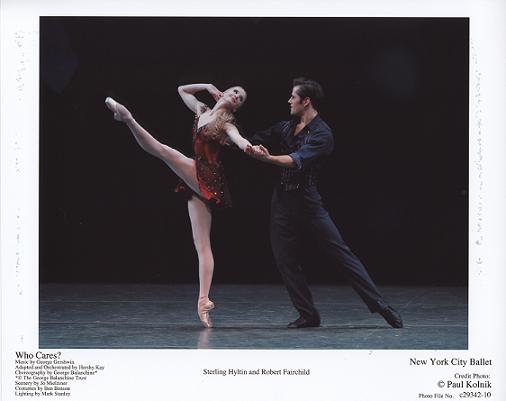
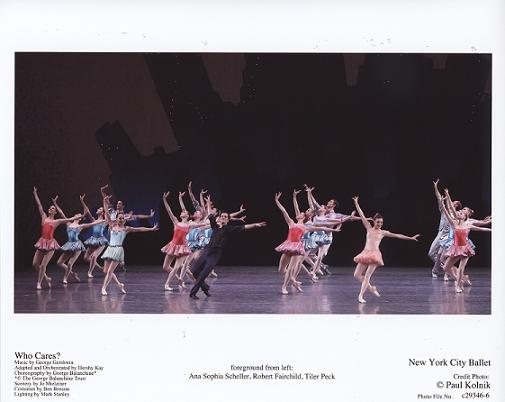
I LOVED Who Cares?! (photos above — of Robert Fairchild and Sterling Hyltin, and of the whole cast — by Paul Kolnik.) I’d only ever seen the pas de deux before and didn’t even realize the whole was comprised of a whole slew of Gershwin songs, some danced by the ensemble, some by only the women, others by only the men, with solos and pas de deux mixed in. I particularly loved Tiler Peck’s duet with Robbie Fairchild in The Man I Love. She has such a clean, beautiful line and she’s so expressive and so engaging. She can make a story out of anything. And of course Fairchild is always the perfect romantic male lead ๐Ÿ™‚ Crowd went wild over his and Ana Sophia Scheller’s duet to Embraceable You as well as Scheller’s My One and Only solo. Such a fun ballet — I’m going back for more this week.

Also shown in that program was Martins’s new Naive and Sentimental Music, set to John Adams’ score of the same name. I wrote about that ballet when it premiered here and posted pics of it here. Seeing it again evoked a bit of Balanchine’s Jewels, particularly the lovely lyrical white section (my favorite) and the sexy red.

One little thing I have to say: this ballet was created on and is danced only by principals but Adrian Danchig-Waring danced in last week’s production as well, and he is still a soloist (I think he may have been replacing Amar Ramasar, who must be injured because he was replaced a few times over the week…) Anyway, I realize NYCB is top heavy at the moment, but I think Danchig-Waring definitely needs to be next in line for a promotion!

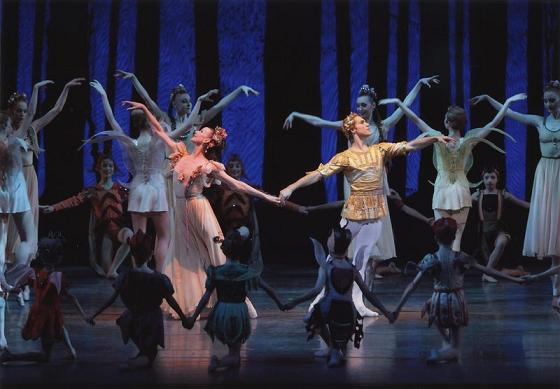
And earlier in the week I saw the best EVER cast ofย  Midsummer Night’s Dream. I finally got to see my Gonzalo Garcia as Oberon ๐Ÿ˜€ (photo above by Paul Kolnik, of Garcia as Oberon and Darci Kistler as Titania). I’d missed him in this role at the end of last season. He did very well – -not only with the dancing — particularly that crazy fast scherzo — but also, and less expected for me, with the acting. I thought he’d be a sweet, glowingly endearing Oberon, but, no, he was a pissy, demanding fairy king — just as much as Andrew Veyette last season (cutely pissy and demanding though!) He wanted Titania’s servant boy and he wasn’t letting her say no to him. Only thing regarding the dancing — his legs don’t seem to be as flexible as they once were. It seems like he may have injured an adductor muscle, or else he’s built up so much thigh muscle or something — but his legs when he jumps are not making perfect splits. But his upper body is so fluid and graceful and he exudes such charm that he’s still the perfect lyrical male dancer nonetheless.

Titania was the beautiful Sara Mearns (headshot by Paul Kolnik — a new headshot for her, right?)– and she was the best Titania I’ve personally seen. Oh she’s such a beautiful dancer! She throws herself so fully into every move she makes. If Garcia is the ideal male lyrical dancer she is the ideal female – they were so perfect together.

And I’m so glad Stephen Hanna is back at NYCB (still annoyed with the Billy Elliot directors for not making good enough use of him on Broadway). He was Titania’s cavalier and his pas de deux with Mearns was the best Titania / Cavalier pdd I’ve ever seen. He’s so big and strong — which certainly amps up the romance factor — and his numerous tour jetes just have so much power. Honestly I often get bored during that pdd and just want Oberon to return, but not with Hanna’s cavalier!

And new to the cast of human characters who get their hearts messed with by a mischievous Puck (Troy Schumacher) was Janie Taylor, as Helena. She is another one who excels at story dances, always delving into a character and making clear to the audience what’s going on in her mind. She’s pathetically, endearingly funny from the time she enters the stage all forlorn over Demetrius, to her being completely bewildered by Lysander’s sudden attraction to her, to her searching the forest madly for Demetrius, to her cat-fights with Hermia, etc. She really brought out the humor.

In the section where I was sitting, there were at least three large groups of people you could tell had never seen the ballet before — nor likely the play; they didn’t seem familiar with the story. But they were laughing hysterically throughout the whole thing and were really awed by the dancing, and by some of the tricks (like Puck’s being pulled up to the ceiling via harness at the end). That’s when you can tell with a story ballet that the cast really brought it to life, when the newcomers are enthralled.

HAPPY HOLIDAYS EVERYONE!


Hi you guys. Sorry I’ve been so bad about posting lately. This book –argh! Took me a ridiculously long time to figure out my Kindle conversion! If I wasn’t so computer dyslexic…. Anyway, Kindle version should be up soon on Amazon. Will post when it is.

I have a few blog posts to write — about Alvin Ailey and about Rasta Thomas’s Rock the Ballet which, okay, I admit — I liked!!! — despite (or perhaps of) Roslyn’s almost hilariously scathing review! I liked it, but can definitely see how others wouldn’t.

And Alvin Ailey — they’re in the midst of their City Center season (which ends January 3rd). I’ve loved most of their season premieres — there are several — namely Hymn and Divining by Judith Jamison, and Dancing Spirit by Ronald K. Brown (photo above of Matthew Rushing in Dancing Spirit, photo by Paul Kolnik). Hymn is a really breathtaking tribute to Alvin Ailey — the man himself. It was made in 1993 right after he passed away. It’s with spoken word by Anna Deavere Smith, based on her interviews with Jamison and the company dancers from that time, and on Ailey’s words themselves; choreography is by Jamison. And, Divining and Dancing Spirit are both part African, part ballet / modern. Dancing Spirit starts slowly, then builds to a really beautiful crescendo. Audience went nuts with applause after it premiered, and justifiably so! Definitely do try to go see it before the season ends.

The “20 years” tribute to Jamison’s time with the company is also a great program. Exposes you to excerpts of many of the ballets she commissioned over the years, which I now want badly to see.

Oh, interesting tidbit: one of my friends told me she sat next to SYTYCD’s Tyce Diorio at one of the Ailey perfs, and he highly recommended to her Hymn and Divining. So, see, I know what I’m talking about ๐Ÿ™‚

I also need to blog about Nine, the film, which I saw yesterday. Thought it was okay, not as good as I was expecting. The musical numbers were excellent — especially those led by Kate Hudson, Judi Dench, and Fergie. But the story line is rather boring and slow-moving. And I hate to say this but this is the first thing I haven’t loved Daniel Day Lewis in. He just didn’t become the character to me, like he normally does; just couldn’t inhabit this role. Weird because his Unbearable Lightness of Being character had many of the same flaws, and he was so much more believable as Tomasz than he was here as Guido. Anyone else seen it?

My website (and, thus, this blog) is going to be up and down a bit over the next couple days because I’m having some of the pages re-done. But I will resume blogging very soon. In the meantime, get thee to Alvin Ailey!

Oh, and happy holidays ๐Ÿ™‚

NYCBALLET OPENING NIGHT: NEW MARTINS’ NAIVE & SENTIMENTAL MUSIC A SUCCESS!


New York City Ballet officially opened its 2009-10 winter season last night, with a performance and black tie gala dinner. The performance included Alexei Ratmansky’s Concerto DSCH (above photo of that ballet — dancers are Ana Sophia Scheller, Gonzalo Garcia, and Joaquin De Luz — by Paul Kolnik, taken from NYTimes), stars of the Paris Opera Ballet Aurelie Dupont and Mathias Heymann dancing the central pas de deux from Balanchine’s “Rubies,”


(photo taken from Kulturkompasset; Dupont is center, Heymann is holding the hand of another dancer).

And then the evening finished off with the world premiere of artistic director Peter Martins’ Naive and Sentimental Music, set to John Adams’ (brilliant) score of the same name (I’ll post photos when I receive them).

But first, there was a short film of the reconstruction of the inside of the Koch Theater (still can’t help but think of it as the State Theater…) while the orchestra played Tchaikovsky’s Sleeping Beauty overture (as it turned out, the perfect music to highlight the comically sped-up but ultimately awe-inducingly huge renovation process). Highlights of the renovated theater are — most importantly and coolly — the orchestra pit with a floor that can rise to stage-level (! — and this is how the orchestra played the overture), and two aisles now carved into the orchestra seating section. (Before, orchestra section had no aisles — so, though this is how Balanchine wanted it, apart from being extremely hard getting to a middle seat, it was a fire hazard).

Anyway, after the mandatory thank-you speeches by Peter Martins and David Koch (who funded the renovation), came theย  Ratmansky. The fun frolicking threesome in blue (top photo) were danced by Joaquin De Luz, Gonzalo Garcia and Ashley Bouder (all three brilliantly on, Bouder thankfully back from an injury), and the adagio couple in green were Benjamin Millepied and Wendy Whelan (photo below). I think this was danced better than I’ve ever seen it done before — it could have been because I was so excited to see Bouder return, or because the dancers are all beginning-of-season fresh… but this is by far Ratmansky’s best, imo — it’s got the most complex structure and original movement.


(photo by Paul Kolnik, taken from Danza Ballet)

Next were the POB couple, who danced “Rubies” brilliantly — not only with precision and clarity but with great exuberance as well. One thing I meant to say earlier about La Danse (the Wiseman film about the POB) and forgot, was that the POB dancers are all so trained to make meaning out of every little thing they do — every step, every gesture, no matter how small. You have to have some kind of thought in your mind whatever you do. (This is not what Balanchine taught his dancers; he taught them simply to do his steps and those would contain everything the audience needed to know.) I feel that this allows POB dancers to bring a certain passion and humanity to all of the works they do — I noticed that from performance footage from that film as well as from last night.

And third came the highlight — for me anyway — of the night: the new Peter Martins’ ballet. The John Adams music was absolutely gorgeous — rich, many-layered, complex, intense, varied and structured into many sections — some lighter, many heavier, evocative, etc. etc. Beautiful! Oftentimes music like that overpowers the dancing, but not here.

In a short film shown before the dance (methinks Martins is taking after Wheeldon here with these little introductory films), Adams says the title refers to the difference between musicians whose music was fresh and original (the “naive” composers — like Mozart, he says) and those whose music was meant to speak to the past, to convey a sense of history, music that kind of carried the weight of the world on its shoulders so to speak (the “sentimental” — which he considers Beethoven). You could really see that in the music — some of it lighter, much of it weightier. Martins said in the film he tried to evoke that visually through dance, and I think he did so successfully — there’s a lighter, adagio section with dancers dressed in pristine white, another light but fast section with dancers in red, and then the more intense, almost severe sections with dancers in blues and deep greens and black.

Though most sections are danced in ensemble, Martins created the ballet for the principals only. This created an interesting dynamic, because, except for the middle section with the three pairs of dancers in white, almost all roles had equal weight — and yet practically all of the dancers stood out. It was an overload of star power!

And, though some sections seemed a slight bit underrehearsed (or maybe it was just that the footwork was so difficult and fast), everyone shone since Martins highlighted each dancer’s strengths: Maria Kowroski and Sara Mearns as lyrical women in white, Sterling Hyltin and Teresa Reichlin as kind of sharp-edged, sassy women in fiery red, Andrew Veyette and Daniel Ulbrich at the high-jumping bravura guys in black, there were some jazzy moves for Amar Ramasar, etc. etc.

Oh and I just love Tyler Angle ๐Ÿ™‚ He partnered Yvonne Borree and I don’t think I’ve ever seen her so at ease and so fluid! She looked really beautiful. Nice also to see Stephen Hanna back from Billy Elliot! He partnered Darci Kistler in the white section.

It’s a rather long ballet but I was thoroughly engrossed and can’t wait to see it again. I hope they keep it in the rep.

Okay, that was the gala. Now onto the Nuts. Regular season begins in January.

PARIS OPERA BALLET STARS TO DANCE IN NYCBALLET OPENING NIGHT


How funny — I was just going on in my last post about how I fell in love with the Paris Opera Ballet through Frederick Wiseman’s currently-showing film La Danse, and now I receive news that two etoiles with that company — Aurelie Dupont (in photo above, taken from Bailarinas) and Mathias Heymann — will be performing with New York City Ballet in their opening night gala, on November 24th. In exchange, NYCB’s Ashley Bouder and Gonzalo Garcia (both SLSG faves) will perform with Paris Opera Ballet, on November 12th. Both couples will dance the “Rubies” section of Balanchine’s Jewels.

Additionally, NYCB’s opening night performance will include Alexei Ratmansky’s Concerto DSCH (my personal favorite of his) and a premiere by Peter Martins set to John Adams music and starring all of the company’s principal dancers.


Photo of DSCH by Paul Kolnik, from NYTimes.

NYCB’s Nutcracker season begins the Friday following opening night, November 27th. Visit the website for tix and info.

Most exciting though about the dancer exchange. I’ve never seen Heymann perform live and I’ve only seen Dupont dance Trisha Brown, not full-out ballet.

Here are a couple videos of Heymann I found on YouTube: first as Bluebird in Sleeping Beauty and second in a contemporary solo:

And here is Dupont as Kitri in Don Q:

Sorry, you guys, I’m just so into videos these days!

ALVIN AILEY ON SO YOU THINK YOU CAN DANCE TONIGHT!


Tonight three dancers from Alvin Ailey American Dance Theater will be on SYTYCD! My favorite modern dance company ๐Ÿ˜€ย  Linda Celeste Sims, Clifton Brown, and Constance Stamatiou (above, left to right, in photos by Andrew Eccles) will perform excerpts from Ulysses Dove’s Episodes, which, if I remember correctly, I found very intense and rather haunting.


(Linda Celeste Sims and Matthew Rushing in Episodes, photo by Paul Kolnik)

If you’re in New York, it’s almost time for Alvin Ailey season here. They open at City Center December 2nd. The season lasts for a month and this year they’re celebrating Judith Jamison’s 20th anniversary as artistic director (last year they celebrated the company’s 50th anniversary).

I so love it when great dancers are on TV!

NEW YORK CITY BALLET PROMOTIONS


Practically all of SLSG’s NYCB favorites who were not already principal dancers in the company have just been promoted: the always magical Kathryn Morgan (above, with Seth Orza in Martins’ Romeo + Juliet), heartthrobs Robert Fairchild and Amar Ramasar, the always dramatically compelling Tiler Peck and Tyler Angle, and the statuesque Teresa Reichlen.

Here are Tiler Peck and Robert Fairchild rehearsing Robbins’ Afternoon of a Faun for the Vail International Dance Festival over the summer.

And here are Tiler Peck and Tyler Angle performing the adagio from Christopher Wheeldon’s Mercurial Manoeuvres at said festival:

All promos are from soloist to principal, except young ‘un Morgan who was moved up from corps member to soloist.

All of the new principals will make their debut as such at NYCB’s winter season opening night gala, on November 24th, in Peter Martins’s new ballet set to John Adams’s Naive and Sentimental Music, which will make its world premier that night.

Visit Oberon for more dancer pix and info.

Above photo by Paul Kolnik from Voice of Dance.

THE SEPTEMBER ISSUE IS NOT THE DEVIL WEARS PRADA (BUT COULD USE MORE DANCERS!)


Over the weekend I went to see The September Issue, the documentary about Anna Wintour and Vogue, focusing on the mag’s — well, the fashion industry’s — most important issue of the year. I found it thoroughly entertaining, but not in the way I expected. I expected it to be a real-life Devil Wears Prada, but it wasn’t that at all. I remember from the book, Laurenย  Weisberger’s main character constantly feeling like a horrid slob amongst all the fashionistas — or fashionista wannabes — who worked at the magazine, and I remember her even being ridiculed by everyone for wearing Ann Taylor, supposedly a cheap designer.

Of course Devil Wears Prada, the film, played up on all of that, having Meryl Streep lecture Anne Hathaway on her decidedly frumpy wardrobe and call her (a size 6) “fat.” But here, everyone who works at Vogue — particularly Wintour and other higher-ups like creative director Grace Coddington (who is really the emotional centerpiece of the film) are pretty mundanely dressed. They seem more like incredibly hard-working women who are far too busy to care much about how they look everyday at the office. No one wears much makeup, hair looks completely unstyled, Coddington munches on a rather bland-looking corner deli-bought salad while enthusing about the photo-shoots she’s designed and her romantic vision for the issue, talking about her past as a model and how she turned to the editorial side of things early on after a car accident ended her modeling career, and bemoaning the wasted money spent on photo spreads Wintour ended up not liking and axing entirely.

But my biggest surprise was how unattractive I found the models to be. And they weren’t — they were all really beautiful. But I think I’ve seen so much dance now that, as much as I used to admire models, I’m now almost horrified at their bad posture, their boney bodies, their completely uncoordinated frames, their sloppy-looking lines. During a shoot, this one model was playing around and she decided to do a kick — a battement — for the photographer and it was just about the worst kick I’ve ever seen. Her knee was bent awkwardly, her foot was doing nothing at all and gave her leg no line, and she almost fell over. The photographer seemed to think it was great though.

Made me think how much better dancers might be at making the clothes look good. I don’t know, maybe most dancers are too short or the fabric doesn’t drape as well over built musculature as it does over basically skin-covered bone.


This wasn’t the same model from the film — I can’t find a photo of her — but it’s taken from Italian Vogue. I mean the clothes look good — she’s pretty — but look at her lines underneath…

This in contrast to the New York City Ballet dancers, as photographed with this gorgeous flowing diaphanous fabric for NYCB’s Winter season calendar, which I just received in the mail today.


MIDSUMMER NIGHT’S DREAMS


Last week, I saw two Midsummer Night’s Dreams at New York City Ballet. This was my first time ever seeing Balanchine’s version of the ballet and it was really sweet. It follows the Shakespeare pretty closely: Theseus, Duke of Athens is to be wed to Amazonian queen Hippolyta and Hermia is to be wed to Demetrius. But Hermia doesn’t love Demetrius, she loves Lysander, but her father insists she obey him and marry Demetrius. She and Lysander elope and wander the forest. But first, Hermia informs her friend Helena of her plans. But Helena is in love with Demetrius, a love he doesn’t return. He is in fact quite rude to her. So she decides to try to win his favor by telling him of Hermia and Lysander’s plan of escape.

Meanwhile in the land of the fairies, King Oberon and Queen Titania are fighting because Titania refuses to give Oberon her boy servant, which Oberon badly wants. So Oberon arranges for his friend, the devious Puck, to apply a magical potion to Titania’s eyes while she’s asleep that will make her fall in love with the first person she sees on awaking. After turning a man from the wedding entertainment troupe into an ass, Puck applies the potion to Titania and arranges for her to fall in love with the man/donkey when she awakes, which she does.


Angry about Demetrius treating Helena badly, Oberon also instructs Puck to put the potion on Demetrius’s eyes so that he will fall in love with Helena. But Puck mixes up Demetrius with Lysander and Lysander falls in love with Helena, to Hermia’s obviously great dismay. The two women fight, and the two men fight over Helena. Puck eventually realizes his mistake, rights his wrong, and Demetrius ends up with Helena, Lysander with Hermia. Eventually, he changes the entertainer back into a human and Titania and Oberon make up, she giving him the servant.

The story’s told entirely in the first act, the second consists only of a celebratory divertissement of a three-way wedding between Theseus and Hippolyta, Lysander and Hermia, and Demetrius and Helena.

On my first night seeing this, Faye Arthurs and Abi Stafford most stood out to me as Helena and Hermia respectively. Abi in particular danced with more emotion that I’ve ever seen before from her. I really felt sorry for her when Lysander ran off with Helena and she ran through the forest, searching desperately for her lost love, and scared like a child. Sometimes she disappears to me in the story-less Balanchine or Robbins ballets, which makes me think maybe she needs more roles like this, where she can really delve into a character, because she really blew me away. I haven’t seen much of Faye Arthurs, but she was really hair-pullingly tormented by Demetrius. I really felt for her too. Give these two wonderful women more acting roles, Mr. Martins!

My first Oberon was Antonio Carmena, who danced the role very very well.


There’s a very difficult Scherzo (a humorous section of music with a typically very fast tempo) with lots of high jumps with the fluttering bird-like beats of the feet and multiple turns, and he pulled it off very well. He was a rather nice Oberon, seeming to ask Maria Kowroski’s spectacular Titania nicely for the boy-servant and for Puck to commit his mischief (rather than to demand those things of them).

Andrew Veyette was my Oberon the second night I saw the ballet and I loved his interpretation. Andrew’s a more virile dancer and he made all the demands Antonio’s Oberon did not. Overall, Veyette was probably my favorite dancer in the whole two nights.


Andrew’s Oberon was a deliciously pissed off fairy god, a real match for Teresa Reichlen’s stunning Titania and Daniel Ulbricht’s over-the-top Puck, directing the two of them all around this way and that. Daniel Ulbricht as Puck was of course an excellent jumper, as always — and he did these moves where it looked like he was running in the air. Others do more of a cute scampering hop, but he’s able to really run in the air because he attains such height on those jumps. He’s a true gymnast, you can tell from his body when he’s not in tights! But critics have noted that he tends to take over, make Puck the central figure of this ballet when he dances it. Not here. At least not in my mind. Andrew’s Oberon was most definitely the main character. He has too much virility and command to ever let anyone else take over, whatever he’s dancing.

One other thing about Ulbricht: audiences really seem to love him. I’m not a sucker for the high jumps and the pyrotechnics unless they’re necessary to character (though, looking back, I admit I was more of a sucker for that kind of thing when I first started watching ballet). I think audiences go completely wild for that though and I think they expect him to be cast as Puck and when he’s not, they feel cheated. When it was announced he’d be subbing for an injured Sean Suozzi the audience went wild with applause, making me feel sorry for Suozzi. If I was Peter Martins, I’d try to cast Ulbricht as Puck for every single performance, if possible, so as not to upset audiences. Seriously.

Robert Fairchild, making his Lysander debut Thursday night, was cute in the role, as always, as was Sterling Hyltin as Hermia. And Henry Seth was a cutely funny Bottom. He had the slurred-footed “donkey” moves a little more down pat than Adrian Danchig-Waring on the previous night, and you could practically see through his donkey head his hilarious inner conflict over whether to go for that grass or the beautiful Titania.

Savannah Lowery really stood out to me Thursday night as the huntress Amazonian queen Hippolyta. She did her multiple whipping fouette turns like no one’s business. She’s a very strong dancer. An excellent performance.

And Jared Angle did really well as the leading man in the divertissement adagio, which he danced Thursday night with Jenifer Ringer. He strikes me as a very good, very caring partner who will really take care of his lady. And he’s well cast in these noble roles, like his brother Tyler. I think Sebastien Marcovici is likewise a very good partner and he always makes sure he saves his woman before worrying about himself. He worked very hard Wednesday night in that divertissement adagio and big huge kudos to him. The ballerina he was partnering was having a real struggle with her nerves out there — it was visible, and I felt very sorry and nervous for her. It made me wonder whether there’s anything dancers can take for their nerves, to calm them down without making them so relaxed their dancing suffers? I don’t know, is there? Anyway, there are lots of very good, strong male partners in New York City Ballet.

Ariel and I thought we spotted actor Jeff Goldblum in the audience on Wednesday night.