
Happy Super Tuesday, everyone! And happy NY Giants parade, NYers 🙂
Hills!!!
Oh my gosh, oh my gosh, oh my gosh!!! Okay, I can breathe again. Haven’t been able to do so for a few days now…
Sitting in the gay man section …
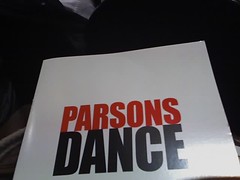
Sitting in the gay man section …
Originally uploaded by swan lake samba girl via mobile.
Should be fun!
Update: Actually the whole theater turned out to be the gay section 🙂 Mr. Parsons is very popular amongst a certain population… Hehe, I can see why; it was a lot of fun and he’s got some very good dancers in his troupe. His piece “Caught” appears to be his claim to fame. In it, a man frantically runs toward various lights shining down from above and dances underneath their heat. But then the lights leave him and focus on another part of the stage. At one point, strobe lights just begin flashing all over the stage, completely overtaking him, and he can’t escape. He dances, doing some amazing moves — continuous grand jetes, high twisty jumps — as the lights continue to flash on him. It’s an amazing visual effect — he looks like he’s literally flying, never coming down to the ground — and he must be very focused to be able to dance in all that chaos. I’ve seen things not unlike this before, but the audience was going completely nuts with applause. The guy next to me said to his boyfriend, “it’s worth the price of admission for that alone!”
Parsons also does some interesting things with the body, the male body in particular. His main muse appears to be male dancer Miguel Quinones, judging from the first program. At one point Quinones does these really jazzy barrel turns, where he kind of shakes and shimmies his whole body on each rotation. He doesn’t always gain as much height as a classical ballet dancer, but it’s incredible that he can move so in the midst of the turn. (I was sitting next to a critic — I think the guy from the New Jersey Ledger. His pen started going the same time mine did at those amazing turns 🙂 ) At another point, Quinones did a lovely arabesque, but instead of remaining still, he did these body rolls, starting from his hips and undulating up through his waist, torso, chest, shoulders, then out to the fingers of the outstretched arm — all the while steadily balancing on one leg, the other beautifully lifted behind.
Anyway, I’m going to Program B as well, and I’ll do a write up after! They’re at the Joyce Theater in Chelsea through Jan. 20th.
Okay, gotta go glue myself to the TV — Oh my gosh, Hillary won, Hillary won, HILLARY WON!!!
I Second Anthony Lane on "Persepolis"
…in giving this film an overall not so fresh tomato. And I mean second literally — everyone is raving about this movie; Lane (my favorite of all art critics) is the only one who hasn’t. Of course I’ve been looking so forward to seeing it, and of course that’s never a good thing, with me at least. With the exception of Alvin Ailey, it seems that everything I’ve looked forward to lately I’ve ended up being disappointed with.
Anyway, this is a graphic film, in French with English subtitles, based on Marjane Satrapi’s graphic memoirs about growing up in Iran during the country’s political turmoil of the 1970s: first the displacement of the Shah, followed by the violent revolutionary war, then the oppressive regime of Khomeni. At the movie’s start, the Shah is being overthrown and of course there are all kinds of imprisonments and murders. Marji’s father and uncle are supporters of the revolution and the movie begins with them telling her (and us) in detail about the politics of the period, and why the Shah is bad for the country. To me, this is not only confusing but becomes very boring very fast: I like my narratives to be character-driven; if I want to know about the politics of a time, I’ll consult a history book. Plus, Marji’s only about four years old when they’re feeding her these views, so how much can such a young child take in anyway? Just showing Marji’s family and friends being taken away and not heard from again from her child’s point of view makes enough of a statement. But, fortunately, we only get this for about the first twenty minutes; then we delve more into the characters.
I think my biggest problem was that I couldn’t fully connect to Marji. Having learned from her outspoken grandmother and mother to speak her mind, she challenges her teachers’ authority when they spout political propaganda in the classroom, then flouts police commands to wear her veil on the streets. Fearing for her safety, her parents send her off to a French school in Vienna. But several other people, including her grandfather who is severely in need of medical attention unavailable in Iran, have been denied passports, so I was curious at how quick and easy it was for her parents to obtain the necessary documents. That’s never explained.
It’s at her school in Vienna where she reaches puberty and begins her studies in earnest, discovering major philiosophers and knowledge she’s been denied in her home country, as well as lipstick, fashion and boys. She falls in with a group of young French intellectuals, which seems to suit her well, she has fun going to parties and meeting new people, and she gets her first boyfriend. But she has problems generally getting along with people. Though most of the students at her school come from international backgrounds, she feels out of place as an Iranian. And her aunt, to whose security her parents had entrusted her, promptly and inexplicably throws her out of her house and into a convent. Marji doesn’t get along with the nuns and their strict rules, so she runs away and becomes a border at the home of an older woman whom she fights with as well. Then, most astounding to me, after surviving the horrors of wartorn Iran, witnessing bombs destroy neighboring houses and their inhabitants, watching relatives be hauled off by the police, and hearing of their murders, she ends up having a breakdown over her boyfriend’s unfaithfulness. In a fit of anger, she leaves the house where she has been staying, begins living on the streets, catches bronchitis and nearly dies — supposedly over the boy. In the hospital, she calls her parents and asks to return.
She returns to Iran grown, the war now over but the oppressive regime firmly in place: the police are everywhere making arrests if women don’t wear veils in public, if they suspect people of going to or coming from a party where there’s been alcohol consumption, if someone is dressed in too Western a manner, etc. etc. Her family organizes a sweet extended family reunion for her, but, having come of age in the West, she now feels disconnected from everyone she knows. She begins seeing a shrink (how middle-class, how American?…) who pronounces her depressed and gives her meds that don’t work. Eventually, she is able to pull herself out of it and begin an Art degree, but after police arrest her and a new boyfriend for holding hands in a car, she decides, at 21, to marry the man and give up her education. And this is where I really felt like walking out of the theater. After surviving all that she has, she makes so many ridiculously stupid choices: nearly killing herself over a cheating boy, getting married and giving up her education because she can’t hold hands with a man in public?… I can’t even understand what she’s doing back in Iran in the first place and I want to scream at her to go back to Europe.
Anyway, eventually a resolution is reached and the ending hints that Marji has been able to find a kind of peace with herself. I’m definitely glad I saw the movie because it does give you a good sense of what it was like to live in Iran during the reign of Khomeni. But as an examination of displacement, exile and identity, I felt it was lacking, that it didn’t hold a candle to something like Andrei Makine’s brilliant “Dreams of My Russian Summers.” When when when are they going to make that into a movie?! (Actually, I have no idea how they’d make a film out of that book — it is so perfect as a novel; I just want everyone I know to be exposed to it, and unfortunately many more people see movies than read…)
But having said all of this, Persepolis has been nominated and received all kinds of awards, and everyone besides Lane is raving about it (and he wasn’t that harsh, for Lane anyway; only said it was “simple”), so I’d be interested to hear what others saw in it, if anyone did?
New York Lawyers Rallying in Support of Our Pakistani Brethren
Today I was invited via an email from the New York City Bar Association to a rally on the steps of the Supreme Courthouse in support of Pakistani judges and lawyers who have been dismissed from their positions, placed under arrest and some even tortured by President Musharraf’s military dictatorship that took hold on November 6th. To be honest, I’ve been so insanely busy lately, I’m embarrassed to say, I didn’t really know what was going on in Pakistan. One important benefit to being a member of the Bar!
So, earlier this month, Musharraf used his power as Army Chief of Staff to declare a state of emergency and suspend the nation’s Constitution. Non-government TV stations were shut down, as were all cell phone lines. Paramilitary troops surrounded the Supreme Court and all judges were dismissed, replaced by judges who pledged loyalty to the military regime. The President of the Bar Association and civil rights attorneys who protested the crackdown, among others, were arrested. Thousands others have been beaten in the streets, rounded up and arrested.
It was a good rally, organized by the New York County, City, and State Bar Associations, the Muslim Bar, Women’s Bar, and Amnesty International. There were several speakers, including the presidents of all organizing Bar associations and a man whose name I didn’t get but whose father is one of the currently detained judges.
To read more about what is going on in Pakistan, go here and here and here.
Mesmerizing Traditional Thai Dance Versus Dumb White People Tricks
Last night I had my first Jerome Bel experience at Dance Theater Workshop in Chelsea. I went to see the latest work by the French experimental choreographer known for refusing to return the money of disgruntled customers, entitled “Pichet Klunchun and myself.” In the piece, which the program says is an exploration of “very problematic notions such as euro-centrism, inter-culturalism or cultural globalization,” Bel and Thai dancer Klunchun (who is brilliant, by the way) sit on chairs across from each other, Bel with a laptop on his knees. Bel first interviews Klunchun, asking him about his work, Thai culture, the type of dance he practices — “Khon” — a centuries-old Thai dance, and asks him to illustrate various moves. Klunchun then queries Bel about the same regarding himself. The first half of the program I found fascinating and I recommend that everyone in NYC go see it (showing through Saturday, the 10th) for that reason alone.
Khon, Klunchun reveals, began with a Thai king, who danced himself, and is a celebration of Buddha. The body is literally like a temple, the Buddha contained within both the center of the body and the center of the temple. So, arms legs, hands and feet, like Thai architecture, are shaped so that the energy flows out from the center, down through the limbs and rooftop structures, and is then re-directed back to the center, to the Buddha of the temple and soul. That’s why Thai dancers hold their hands and feet as such, which the fingers and toes splayed and flexed outward and upward. After he gives this explanation and begins dancing, you can really see the arcs of energy radiating out and back and out and back. Thai dancers practice flexing their fingers backward, and he shows us how. Ouch! Bel tried to flex his own, but to no avail. I tried as well, equally unsuccessful. It looks like it takes as much work as balletic turnout.
I found his this fascinating, along with Klunchun’s illustrations. At one point, he walks slowly slowly slowly across the room, showing how the spirit of a character who has died inhabits the stage (this after Bel asks him to feign dying onstage and Klunchun says he can’t; for a character to die onstage is for the king to die, for the country to die). Anyway, in his walks, the feet slowly lift from the floor, almost toe by toe, then the knee slowly bends, the leg rises, lifts, extends out, bends, the foot slowly drops to the floor, the step only ending when the last toe has touched ground. I can’t explain — you just have to see for yourself — but it was mesmerizing. His movements were so perfectly stylized down to the very last detail, so formalized, not a skin cell out of place. It really made me want to see the Thai dancer in David Michalek’s Slow Dancing films again, especially now that I understand the movement. He illustrated the four main characters of Khon: male, female, demon, and monkey — demon being his specialty; monkey he can’t do to save his life (my word choice of course; his language, like his dancing was very formal and ascetic). At first I couldn’t see the difference between the characters, but after Bel asked him to explain, I understood. Everything is so subtle. You have to watch really closely. And you will because it’s really so breathtaking in its simplicity. When Klunchun finally danced the role of a woman learning that her husband had died, I understood every movement, every discreet but articulated gesture to a tee. Beautiful! Bel thought so too.
Throughout Bel’s interrogatories, there were little culture clashes, most of which I felt were forced and contrived. Bel exclaims to Klunchun that Western dance (meaning ballet) also originated from a king — King Louis. But it’s a superficial similarity, of course, as, far from having the energy re-directed to one’s inward Buddha: the French king demanded that his court dancers have their bodies always turned not straight ahead, but toward him, thus the balletic turnout. “You direct your energy out,” Klunchun says at one point, demonstrating a very funny faux grand jete. “Out, out, out,” he said as he leaped through the air throwing his arms up. He was really quite an actor and could be very funny in his deadpan seriousness.
Then Bel turned the tables and asked Klunchun what he would like to know. After the exchange of some personal details intended to reveal cultural differences (Klunchun doesn’t understand how Bel can be unmarried and have a child, for example), Bel gets up and illustrates his work. He plays music from his computer. The song is “Let’s Dance” by David Bowie. Bel walks to center stage and stands stationary, looking out at the audience, eyeing us left to right. After about a minute, he begins jumping around, breaking into an unsophisticated version of club dance. After another minute or two of doing that, he sits. Klunchun, playing the outsider / voice of reason asks him, basically, WTF?? (my words again). Bel explains that in France they had a Revolution during which commoners overthrew all of the royals, sparing no family members. Hence, long live the French principle of egalite. He is deconstructing the spectator / performer dichotomy, showing the audience that he is just like them, no better. “But why then would they pay?” asks the voice of reason. “Well, they sometimes want their money back, in fact,” says Bel. The audience erupts with laughter — clearly these are all Bel groupies in the know about his history. “And do you give it back?” asks Klunchun. “No.” You see, Bel explains, he is a “contemporary” artist — this means not ballet, not Swan Lake, not the Nutcracker. “Contemporary” means there can be no expectations, no preconceived notions. It’s in the present. The government pays him a lot of money to go out and do research on this present state of things, about which he then produces work. He walks back to center stage, throws a vase of pencils and other small object onto the floor, falls down, and pretends to fall asleep atop the objects. Not to sound like a philistine, but I really don’t understand what kind of research one needs to do in order to come up with this, Mr. Bel?
Later, Bel talks about the work I think he is most known for, “Jerome Bel,” in which a man and woman, both naked, come out onstage, stand, look down at their bodies, and begin scrunching together a role of fat from their waists, which they kneed up and down and all around, distributing the fat throughout their torsos. “The body is such a marvel in and of itself,” Bel exclaims orgiastically, “who needs movement!” With this piece, he says, he was trying to explore the bare essentials of theater. What better way to do that than by having a stage with no props, no costumes and hardly any light?
Okay, knowing me, this is the kind of thing I would have thought was brilliant — or maybe not brilliant but something I would have at least been into — when I was in college, so I do see where he has his followers. After last night, I have decided that I am not, however, one of them, if my tone hasn’t made that obvious. Having only seen this one piece of his, though, I could be missing something. Here is another perspective from someone I highly admire.
At the end, Bel has just finished sleeping onstage for several minutes to “Killing Me Softly,” when he gets up and begins to pull down his pants. “No, no,” Klunchun stops him. “I don’t, I don’t want to see you naked, Mr. Bel, it is not right.” “Why,” says Bel unzipping. “Because in Thailand, there are certain people you, you don’t share nakedness with,” Klunchun says visibly distraught. “But, Mr. Klunchun,” Bel snickers, “in Bangkok clubs, there’s lots of nudity.” “That’s different,” Klunchun says, averting his eyes, unable to hide a look of disgust, “they’re, they’re working.” “I’m working too,” Bel says with the tone of a high-schooler. “But in Bangkok, they’re working for tourists.” With this the Bel groupies moaned as if the skies had parted. The international trafficking of women as sex slaves has long been one of the most disturbing social issues to me, so this may well not be everyone’s reaction, but I found it completely insulting that Bel assumed that I didn’t already know the truth of Klunchun’s last line, that that was supposed to be a revelation to me as a white person.
Anyway, as I said, “Pichet Klunchun and myself” is totally worth seeing for Klunchun alone. Who knows, you may up enjoying the deconstructionist French guy as well. Go here for tix.
Capitalism, Poetic Clothes hangers, and $500 Apartments in the Village?!
Last night I went to see experimental choreographer John Jasperse‘s new work “Misuse Liable to Prosecution” at BAM’s Harvey theater in Brooklyn. Fun night! I went with Tony Schultz from the Winger, and we met up with some of his friends, one of whom is Ashley Byler, an up and coming choreographer who also contributes to the Winger and just landed a coveted residency at experimental dance venue Dance Theater Workshop in Chelsea. (Her first show will be in May.) We all went out for drinks and little foodie things afterward at nearby Scopello, which I loved. Very good food, spacious comfy area and very decent prices. I guess this is why people live in the outer boroughs… Everyone was so smart and it was a great time hanging out and talking about dance and art and Jasperse and Chuck Close and Labannotation, and all kinds of compelling stuff! I didn’t get home until early this morning, which is why I’m late with my review…
Anyway, Jasperse. Ashley and Tony loved it, I liked but didn’t love it, but thought certain parts were brilliant. According to the program notes, Jasperse began with the idea, “What is it like to exist in a capitalist society with little or no capital?” Sets and props are comprised of other people’s discarded items — clothes hangers, brooms, milk crates, bottles, etc., which Jasperse and his group of four dancers seek to re-invent, finding new, poetic meaning in society’s refuse. So, I guess by finding new uses and meaning in what society deems trash, while starting with the initial capitalist question, he is in a roundabout way perhaps questioning what a capitalist society finds meaningful (work that produces money) and what it doesn’t (experimental art / art in general).
I felt that the most brilliant reinvention of trash was the set. As I walked into the theater, my eye was immediately drawn to the stage, which looked ablaze with gleaming white holiday lights weaved into some kind of intricate snowflake formation. It was really breathtaking. Once I sat down and looked more closely though, I realized the Christmas lights were actually about 1,000 ordinary clear plastic clothes hangers. The way the plastic was lit by stage lights produced the glowing effect. It reminded of a sculpture I once saw in an American exhibit in the then newly-opened Kiasma Museum of contemporary art in Helsinki. From afar this striking piece hanging from the ceiling looked like a gorgeous chandelier. But on closer inspection I realized it was made entirely of chicken bones, which made me momentarily disgusted. I had to walk away, but I then kept returning to that piece, it was so jarringly mesmerizing. When I first saw the coat hanger sculpture, part of which hung quite close to the stage, forcing the dancers to interact with pieces of it, I thought it was brilliant. I felt that the movement, though, just didn’t rise to that same level.
As four dancers walked slowly around the stage carefully balancing several tied-together broomsticks on their heads, Jasperse came up front, sat on a milk crate (the name of the work, by the way, comes from a warning on a milk crate, which is really rather funny when you think about it — what possible wrongful, prosecution-inducing uses are there for a milk crate?), propped an orange traffic cone on top of a broomstick, and used the cone as a bullhorn reading various economic statistics through it: Judge Judy’s salary is something like $26 million more than that of all of the United States Supreme Court justices combined (which enrages me), employees of small arthouse BAM make half of what those of Manhattan’s posh Lincoln Center do, how much our government spends on the Iraq war as compared to funding for the arts (don’t even ask), how much money Jasperse makes ($26,000), and his various expenses, including those involved in transporting props to the studio, rehearsal space fees, food, and, most audience-wowing, his apartment — $500 a month, in the Village! Well, that’s certainly a thing of value, Mr. Jasperse! (For non-New Yorkers, the average teensy one-bedroom in the Village is currently going for $3350, says my friend who is looking.)
Anyway, after these stats are read, Mr. Jasperse joins the other dancers interacting with various props. Music is played by a woman (musician Zeena Parkins) standing off to the side wearing a mini-dress made of FedEx envelopes who plays a homemade industrial-looking harp. Bagpipes occasionally sound from above, from musicians standing on the balcony sides.
Some of my favorite moments: a dancer brings Mr. Jasperse a large box containing an item he seems to have purchased. He opens the box, finds a bean bag chair. He takes the chair out and looks quizzically at it, as the dancer throws the open box over his head. He takes the box off and begins playing with the bean bag chair, eventually with others, who throw it at each other like a giant hacky sack. Eventually, when the players tire of the game, Jasperse winds up with the bean bag chair over his head, walking around stage completely unable to see or breathe, stumbling into the clothes hanger sculpture. So, it’s like he’s been consumed by his own consumption.
Another favorite moment: four dancers take off their jeans. They then sit down on the ground and meticulously begin to fold the pants, like you see Banana Republic and Gap employees often doing. As soon as they’ve smoothed them all out, ready to be presented to the customer on the display table, the dancers lie down on them, use them as bed and blanket, wend their feet through the pants legs, eventually getting all tangled up. They then rise, untangle themselves, take the pants in one hand, grab the bottom of a leg, and begin whirling them around over head like a lasso. They whip the pants at the floor, each other, and eventually into the back wall. I saw in this well-founded anger at all those horrendous chain stores that have completely taken over and all but ruined parts of the city like SoHo, which, for non-New Yorkers, used to be the gallery district and is now basically a mall.
At another point, a male and female dancer take a clothes line on which several garments are hung, lie down, and, using only their feet, somehow weave the clothes all into the woman’s top. She ends up a Humpty-Dumpty-esque literal “stuffed shirt.”
A part the audience found amazing, judging by the ooohs and aaaahs: two women roll out a sheet as if they’re about to have a picnic. They disappear into the wings and return with several water bottles, which they put onto their picnic cloth. They disappear again, making me think they were going to get their baskets filled with food. But instead they return with more bottles, then more and more, until it’s not they who are having a picnic at all but the water bottles themselves. They then lie on the sheets amongst the bottles, and, using only their feet and legs, scrunch up the sheet so that eventually they have several water bottles lined up between their legs. They lift their legs in the air, rotate them, the bottles still held tightly between legs, then one by one deposit each bottle into the sheet, still using only their legs. I guess it is a difficult feat, but what was this supposed to mean? At another point, one which takes up a large part of the whole, a mattress is brought out and dancers thrash themselves at it, the mattress eventually enveloping a dancer as had the bean bag chair earlier. But the bean bag chair had arrived in a box, so it was like a purchase; the mattress was just lugged out onstage. A lot of these kinds of uses of the props were comical and interesting and involved difficult feats using entwined limbs, but some of them I couldn’t figure any meaning into, and none had the poetry of the clothes hanger set.
At the end, Jasperse returns to his traffic-cone megaphone and tells the audience that he couldn’t really figure out how to end the piece. He thought of lining the theater’s edges with explosives and setting them off like firecrackers so that the walls would fall like dominoes and the ceiling would open up so we could see the sky. The audience cracked up at this. Realizing that wouldn’t do, he asked us all to take a deep breath and open our imaginations instead. He gave us a moment to do so, then told us all he hoped we enjoyed the rest of our evenings. It felt like the end of a yoga class.
I guess it’s kind of one of those things where everyone takes away something different. Here’s Counter Critic’s review, and here’s Jennifer Dunning’s in the Times. It’s showing tonight and tomorrow, go here for tix.
Carlos Acosta Movie In The Making? Yes Please!
Judith Mackrell from London’s Guardian newspaper blogs that, according to the BBC News, Hollywood is interested in making a movie based on the life of Cuban ballet dancer Carlos Acosta (who is now with the Royal Ballet in London and has formerly been with ABT and still sometimes guests with my favorite company; Danny Tidwell has listed him as one of his heroes, along with my love Jose 🙂 who also happens to be Cuban).
Anyway, this project is so exciting to me. I remember when I was young and “White Nights” starring Baryshnikov came out. Everyone was talking. I remember seeing pictures in the newspapers of little Alexandra Baryshnikova (several years younger than me — wonder where she is now?…) being lifted out of a limousine by her father to accompany him down the red carpet for the film’s premiere. I remember all the talk about nude pictures Baryshnikov posed for with co-actor Isabella Rossellini to promote the film and his then-scandalous out-of-wedlock affair with Alexandra’s mother, Jessica Lange. I remember all the network news stories reporting that the little girl cried during the film when the KGB agents threatened her father and had to be comforted by him. I remember eventually seeing the film with my mom and thinking how fun was the tap dancer (Gregory Hines) and how beautiful and polished and smooth were Baryshnikov’s pirouettes (and how many he could do!), and I remember finding the KGB people thrillingly scary but their accents so attractive. I was too young really to appreciate the art of dance, other than Baryshnikov’s perfect, dizzying, never-ending turns, and I don’t even remember the film’s full plot, but to me ballet became this world filled with exotic beauty, intrigue, spies, scandalous taboo-breaking, glamour, Hollywood, the global political situation. Ballet was enchanting and beautiful in itself but it also heavily involved the world around us.
I think it’s time for another big ballet movie. I think perhaps Danny Tidwell has paved the way for mass audience appreciation of the dance, at least in this country. He may have called himself “contemporary” on SYTYCD, but that doesn’t matter; people recognize the form as ballet. And what better story than that of a boy born poor and minority in the slums of Havana who became one of the greatest dancers in the world?
The interesting issue is, as Mackrell points out, who is going to portray Acosta? He seems to want to play himself, but that seems odd to me: who has ever played himself in a narrative, non-documentary film? And talk about the potential for a struggle over artistic control between director and actors… “White Nights” was not the story of Baryshnikov’s life but rather very loosely based on what might happen if a plane he was on crash-landed in Soviet Russia, from which he had just defected. If the Acosta movie is going to be a direct re-telling of his life, I think it makes more sense for a professional actor to play him. But then of course who is going to be able to dance like that?!
Dissing of Kyle Abraham And Shallowness of Ballet World Is Marring My Pasha Excitement
Tonight is the fabulous Dance Times Square escapade to see Pasha et al in the So You Think You Can Dance spectacular. I am really excited about it — have no less than three cameras in my bag just in case of battery outage (though I charged everything anyway — just the neurotic in me) 🙂 I do hope they let us backstage and to take pics; otherwise expect a copious write-up! Good: I was upset this morning after logging onto some of my regular dance websites, and am now feeling better just writing about tonight 🙂 Thanks Pasha, and thanks blogging software 🙂
What I’m really upset about is how shallow the world of ballet seems to be. At the Fall For Dance festival a few days ago I saw a most profound, moving work performed by African American dance-maker Kyle Abraham. As I wrote earlier, to me the piece used a combination of ballet, modern dance and hip hop to explore racial and gender issues and evoke the struggle to break free of prejudices — both those held by others and sometimes subtly taken on yourself. I’m very upset about the complete dismissal and oversight of Abraham’s work by both the press and the blogosphere. NYTimes chief dance critic Alastair Macaulay says only of the work that it was show-offy and involved too much upper-body “archness.” (Macaulay also criticized Wheeldon’s “After the Rain,” which I liked, but I’m not bothered by that because he actually gave it the time of day and analyzed it a teensy tiny bit; I’m far more disturbed by his complete dismissal of the meaning inherent in Abraham with no real analysis to speak of).
Similarly, Justin Peck of the Winger, a NY City Ballet dancer and Columbia University student wrote a little review of the night, perhaps for his class on dance criticism, and in his review of Abraham, he simply names the different dance forms used, then dismisses the piece as lacking “structure” (without further analysis). Neither reviewer seemed even to notice the racial or gender implications of the work. How anyone could fail to hear the loud gunshots and ambulance / police sirens going off at the beginning of the piece is completely beyond me, but I guess I’m a criminal appeals attorney who’s represented poor minorities for the past several years, so such noises may be more resonant to me. (By the way, a bit off topic but important: I think all attorneys should at some point in their careers represent someone whose life is starkly different from their own — even if it’s just pro bono — it expands your universe exponentially).
Then yesterday on The Winger, smart ABT dancer David Hallberg, posted this video of choreography by Mats Ek, whose work he was moved by at the Fall For Dance performance he saw. I thought it was a beautiful, moving portrait of a woman’s sorrow at losing her husband. Others, however, couldn’t see any sorrow, any story, but only focused on dancer Sylvie Guillem’s beautiful feet. Yes, Guillem has great feet. But is an attractive body part what really draws people to this art form? Is that what ballet is all about? Prettiness? Is it not about meaning, about moving people by telling them a compelling story, about making people think? Is ballet really that unintellectual? I have two advanced degrees. If you don’t at least try to stimulate my brain cells with your so-called art, I’m perfectly happy to return to favorite novelists who actually explore the human condition.
The problem isn’t just ballet fans though. I feel sometimes that those entrusted with stimulating public discourse are not even trying. (Here I’m primarily speaking of critics who write for the NYTimes, which I admit, is the only paper I regularly read due to both time and money constraints). Claudia LaRocco’s review of the final night of FFD read something like this: this whole festival is stupid, so it goes without saying that everything I saw that night was stupid. The first piece, in addition to being stupid was ethnically insulting in its “cliched” use of Indian dance to characterize London business culture (no further analysis as to exactly what it was about that piece — a huge crowd-pleaser that I found very intriguing — was cliched); the second piece (a brief excerpt of Camille A. Brown’s evocation of a woman trying to find herself) was bad because Brown moved too fast; the third piece was worthless because it was just there (no further analysis); the fourth piece comes from a choreographer (Jorma Elo) whose work always sucks; and the last piece was bad because it was “pleasurable only at a kinesthetic level and only at times.”
The critic character in Laura Jacobs’s novel, “Women About Town,” which I’ve quoted from before, views her work as deciphering for the public just what it is that makes a performance work or not, and unlocking and illuminating the hidden meaning of a piece (“there’s always a key,” she says at one point, though I’ve returned the book to the library so may be getting the exact quote wrong). I just don’t see any of that going on in the world of dance.
Tellingly, LaRocco begins her review by asserting that these days there is such a plethora of crap the best a critic can hope for is “competence.” These critics are coming from a place of anger, not of analysis. Countercritic led me to this article bemoaning how bloggers are displacing professional critics, which, the author argues, is tragic given critics’ historic role in leading the audience to understand and appreciate something in which they couldn’t previously find value (ie: Beckett’s “Waiting For Godot”). Okay, I understand that. But can someone please tell me when was the last time a dance critic illuminated a work of cultural value that was dismissed by the general public instead of the other way around?
I can’t even begin to describe what that auditorium sounded like after the presentation of Elo’s work (the ‘always sucky’ choreographer). His “Brake the Eyes” which I wrote about earlier, was so stunning, so brimming over with meaning, the audience was buzzing with discussion after the china doll / puppet ballerina snapped her fingers and the lights flicked off. “Was she controlled by the others or was it the other way around?” “That combination of music was so interesting!” “What was that cool music besides the Mozart, it doesn’t say in the Playbill.” “What was she saying in Russian?” were some of the questions I overheard. People are starved for analysis. Some of these people (especially the young and internet savvy) are going to come home and Google “Jorma Elo” or “Brake the Eyes,” and what are they going to find? Certainly not analysis. How can the public find meaning in concert dance, see it as anything other than the movement of attractive body parts if the writers aren’t trying to lead them the right direction?
Of course I know newspaper writers are under very strict word count limitations, making it impossible for them to delve very fully into their subject. But in the age of the internet, can’t at least the web articles be longer? Also writer Paul Parish has an interesting analysis of the newspaper problem (go to the very bottom of this post — scroll all the way down to where the bold reads “Paul to Tonya et al” and then to the paragraph that starts “I still think…” Foot in Mouth posts tend to be delectably gargantuan!!!). I don’t entirely understand what Paul is saying, but it sounds intriguing!
Anyway, the closer it gets to 4 pm (when the magic DTS bus departs for SYTYCD land), the better I am feeling. Hopefully I should have a good dance night: there won’t be any ballet there, after all 🙁
Kavanagh on Nureyev: Part I A (i) (a)…
This book (the latest biography of the greatest dancer EVER imho), which officially went on sale yesterday in bookstores everywhere, is so huge it’s almost overwhelming just to look at. I think it makes more sense for me to give my thoughts on the book in segments, so that I don’t end up with a 100,000- word-long review!
In the first couple chapters Kavanagh paints a fairly well-rounded portrait of Rudik’s parents and upbringing. (I hope I don’t sound pretentious, by the way, calling him that — I just think Rudik is so much cuter than Rudolf and more original and “Russian-sounding” than Rudi 🙂 ) He grew up in abject poverty in a provincial state in northern Russia called Ufa, far removed from any city with its attendant vibrant cultural life. His family is Tatar, which is an oppressed ethnic minority in Russia, and he was raised Muslim and Tatar-speaking; didn’t learn Russian until later in school. (I actually hadn’t known Tatar was a language). He had three siblings — all sisters — and his mother, Farida, who had wanted to become a school-teacher but whose hopes for an education were dashed by pregnancy after pregnancy after pregnancy, took care of the children while his father, Hamet, served in the Red Army, his status forever in frightening limbo by Stalin’s erratic demotion / murder sprees.
Rudik was actually born on a train, when Farida went to visit Hamet at his bunk, which is how Kavanagh sweetly starts off her book. Much of his childhood was filled with such train rides, and the family at one point lived near train tracks. Rudik thus retained a life-long fascination with the locomotives, and when he was older and a professional dancer, part of his performance preparation consisted of leaving the studio and sitting outside near train tracks, listening for the sounds of the engines to get their rhythm into his body.
Hamet didn’t return home permanently until Rudik was well into boyhood, and by then, Rudik had been surrounded by so many women, he didn’t know how to react to the presence of a male; he seems to have been a bit afraid of his father. Hamet, well-liked by his comrades, was a real “mensch” type, and freaking out a bit over his son’s effeminacy, tried to make the proverbial man out of him by taking him on hunting trips, etc. Sensitive and quiet by nature, Rudik didn’t fare so well, needless to say, beginning a lifelong struggle with his father, exacerbated of course by his desire to become a dancer. Rudik had the best relationship with his older sister Rosa, the most intellectual and artistic one in the family who took dance and piano lessons and would teach her younger brother what she had learned in her ballet history lectures and bring him home costumes which he would (in his words) “gaze at so intensely that I could feel myself actually inside them. I would fondle them for hours, smooth them and smell them. There is no other word to describe it — I was like a dope addict.”
Rudik was introduced to ballet when he was seven years old and Farida bought a single ticket to a performance in Ufa, and managed to sneak all of her children into the theater with her. He knew then and there what he wanted to do with his life, and he never looked back. But even before that he had shown he was a natural dancer. Starting in kindergarden, as with all Russian children, he took national folk-dancing in school, exhibiting such talent and charisma, he was often chosen as a soloist in his school’s performances which they took on the road, performing in hospitals housing men recovering from war wounds. Kavanagh quotes from the (very well-written and gorgeously descriptive) novel, Dancer, by Colum McCann, which is based on the life of Nureyev. “In the spaces between the beds the children performed . . . Just when we thought they were finished, a small blond boy stepped out of the line. He was about five or six. He extended his leg, placed his hands firmly on his hips and hitched his thumbs at his back . .. the soldiers in their beds propped themselves up. . . Those by the windows shaded their eyes to watch. The boy went to the floor for a squatting dance. When he finished the ward was full of applause…” That’s one of my favorite passages from McCann too and I really love that Kavanagh quotes from a novel.
Because of his family’s poverty, Rudik got a late start on ballet, preventing him from ever acquiring full hip turnout (which must be attained before puberty, when hip ligaments and tendons are still flexible) thus making it all but impossible for him ever to develop wholly proper ballet technique. Poor and poorly clothed (in too-short pants, lacking shoes, etc.), Rudik was often made fun of by his classmates, and he struggled not to let their taunting get to him. When he later began ballet school in Leningrad, he was older than most of the students by several years. In response to their condescending stares, he, rather (in)famously, announced he would outdo them all. Talk about haughty, Shane Sparks (who told Danny Tidwell he was “arrogant”) 🙂 And of course, through eating, breathing, and sleeping ballet basically for the rest of his life, he did outdo them all.
Kavanagh has done an amazing job of gleaning so much information (the book took 10 years to complete), but she includes so much detail that it kind of weighs the narrative down. She also doesn’t footnote, which, I don’t know if it’s the lawyer in me or the former History grad student or what, but it’s driving me nuts. For example, she asserts that Nureyev had a “lifelong willingness to let women martyr themselves for him” (pg. 21) that he derived from his father, then quotes — I guess either Nureyev or Hamet (?) saying, “‘At home she must work harder than her husband and when he is relaxing she must still carry on.'” Where is this from? What’s the context? Who is speaking? I need sources!!!
She also assigns motives to and makes judgments about her subject that to me are a bit ill founded. For example, she argues that Nureyev fabricated that his father had beaten his mother and him, and her basis for claiming that this is a lie is that the other family members denied it — as if a family’s denying allegations of abuse in order to protect one of its own has never been known to happen before. She claims that Nureyev lied because he was angry at his father for his refusal to tolerate his dancing: “There was only one real reason for his contempt: Hamet refused to tolerate his dancing.” (pg. 22). It just doesn’t strike me as all that mind-boggling that someone who’d spent a large part of his life in the military and looked down on his son for his supposed lack of masculinity could be physically rough. Plus, if dancing is your identity, your being, your life, and a parent refuses to acknowledge you, then that’s a pretty profound reason to harbor some hostility.
Okay, that’s all for now; more to come as I read further. Here is Joan Acocella’s review. Here is Gia Kourlas’s interview with Kavanagh. And here is a quoted excerpt of a review from John Carey that I found on James Wolcott’s blog. Reading the excerpt prompted me to Google Carey. And look at this book I found! I wonder what he’d have to say about the Ballet versus “So You Think You Can Dance” debate?! Hmmm, this may have to be next on my reading list…
What What What?
Okay, what bumblehead recommended this movie?! I have got to stop doing this — going to see a movie or play based on the fact that there’s supposed to be some miniscule amount of dancing. (Did the same with Gypsy, knowing only that the production I was to see contained original Jerome Robbins choreography and therefore expecting West Side Story, not realizing “choreography” can sometimes mean simply placement of actors on a stage). Someone — I think it was Dance Magazine in one of their e-newsletters — mentioned that the brilliant Desmond Richardson was to be in this movie (Julie Taymor’s “Across the Universe” — could they have come up with just a slightly more imaginative title??), which, according to the credits, he was, but I have no idea where. Probably in the one scene that looked like it was trying incredibly hard to be something out of The Wall, with cartoonish block-headed military goons doing some kind of group number that looked like it required people slightly more skilled with body movement than actors, but cannot under any circumstances be called dance. Why someone of Desmond’s stature would take on something that amounted to extra work I have no idea.
Anyway, lack of dance and the beautiful Desmond aside, this movie in a word sucked. It was full of cliches, bad acting, an utterly boring and predictable narrative, cheesy cameos (could anyone make Bono look creepier than Taymor), and renditions of the greatest songs of our time that somehow, obscenely sucked the life right out of them (the sole exception to this being “Let it Be” which begins with a young African American boy cowering in the entrails of a burned-out car during a race riot and climaxes with a black choir belting out the lyrics during the slain boy’s funeral).
The only way I made it through the whole thing was this guy. I guess you can’t really blame actors for crappy material; perhaps the fact Joe Anderson gave all the scenes he was in an actual heartbeat attests to his skill. I’ll have to see more of him. Dana Fuchs‘s Janis Joplin-esque diva was fun at the start but somehow began to drain you, likely because of the predictability of her character. I enjoyed her performance far more in the original, off-Broadway play, “Love, Janis.”
Interestingly, there’s a split-second Butoh sequence during one of the Vietnam scenes that failed only semi-miserably because of, once again, the cliched way in which it’s used. Of course, unlike with real Butoh, the dancers here are all women instead of a combo of sexes since male nudity in movies might spook the fifteen-year-old straight boy who it’s assumed is their main patron, or maybe his parents, or whoever … the powers that be who need to maintain for whatever reason the sexist, homophobic status quo. Anyway, I guess kudos to Taymor for even trying to inject a bit of multiculturalism into her film.
The twenty-somethings in my audience cheered wildly at the film’s end, so maybe it’s just that I am just too old for it 🙂 What gets me is, gasp and moan though these young people did during the scenes involving the Vietnam war and the violent police crackdown on campus protesters, do these people see any relevance whatsoever to what is going on in the world today? What’s the difference between the 60s and today? No baby-boom-produced generation gap? Is it because those who are serving in the current war are largely not white and from middle-class families?
So, to the young people who happen to read my blog: perhaps you will really enjoy this movie. If you do see it, though, please please please please please think when you see those aforementioned scenes of all the people coming home in body bags today. Just because they are black and Latino and working-class, unlike the characters in the film, they are still human.
"As Far As We Know" on the Fringe
On Saturday night my friend, Evangelina, invited me to a play showing as part of the currently underway NYC Fringe Festival, in which her husband, Michael Batelli, was an actor. I’ve never been to the Fringe Festival before, and haven’t been to a dramatic play in a while, so it was quite a treat.
“As Far As We Know” is a fictional re-imagining of the true story of an Army reservist who went missing in Iraq in April 2004 after his convoy was ambushed en route to Baghdad. Five days later, Al-Jazeera TV broadcast a videotape showing that 20-year-old reservist (whose real name is Keith Maupin but is here given the name Jake Larkin) surrounded by masked men. Six weeks later, another videotape emerged, showing, possibly, some kind of execution, though the tape was of such poor quality that the Army deemed it “inconclusive” both of whether it indeed showed a slaying, and whether, if so, it was actually that of Maupin. Unlike with all other military persons, journalists, and missionaries shown in similar tapes, Maupin’s body was never recovered, and there has been no word from him or his captors ever since. The Army has since promoted Maupin three times, in abstentia, and his family and friends in his hometown of Batavia, Ohio, continue hopefully to await his return.
I’m embarrassed to admit, but, somehow I’d never heard of Maupin. It’s impossible of course not to find his story immensely powerful and poignant, but I was also intrigued by the fact that, to this day, nearly three years later, there’s been no closure. Captors have been so up front with other kidnappings; either they were oddly out of step on this one, Maupin is still being held, or as the play hints, there was some kind of Army coverup. According to the play the ambush was partly the result of information sent by a Private to an incorrect email address, and Larkin’s drill sergeant, who later left the Army disillusioned, tells Larkin’s sister she believes the troops received inadequate training, ultimately confiding that she feels partly responsible.
The story was, interestingly, told in non-linear fragments and used mixed media (videoclips –both actual footage and tapes filmed by the actors — were interspersed with the staging). My only problem was that I found it a little too unwieldy and lacking in focus, which is, I’d assume, wont to happen when something is directed by the entire ensemble instead of a single person. It was, by turns, about Larkin’s family members and how they dealt with the situation, about the politics of the possible Army coverup, and about the Army personnel assigned to assist the family and act as go-between between family, military and media. Kelly Van Zile, who played Larkin’s sister, was a powerhouse of an actress and she really made me feel the sister’s pain as well as her internalized conflict between anger at and desperate need to believe in the military.
But it’s pretty obvious how the sister is going to feel. I thought a more dramatically interesting focus would be the young female Army captain charged, in her first assignment, with acting as liaison between the Army and the family. At the beginning of her portion of the story, she is shown listening to a tape dictating the proper way to break horrible news to a family: succinctly and with restrained compassion. With the Larkin family, of course, since there is no such “news” but only indefinite puzzlement, her job is near impossible, and infinite in duration (the Army moves her into a hotel down the street from the Larkins). The most powerful, most human scenes are those where the sister’s pain permeates the captain’s continuous attempt at a tough exterior and the captain gives in — first allowing the sister to keep hold of an all-important cell phone giving her instant access to the Pentagon (and on-the-spot news of Larkin), then writing personal checks to pay the distraught family’s utility bills, and eventually, against firm orders, allowing the family to attend an emotional homecoming for the soldiers returning from Larkin’s unit.
Glitches aside, though, it was a very compelling play and I’m definitely going to keep my ears open now for info about Maupin.
I’m late in getting this post up seeing as how it’s now mid-week, but kind of coincidental given that I received an email today from one of our servicemen, Paul, from Stamford, Connecticut, now serving in Iraq. Paul tells me that he’s enjoying learning some salsa dancing over there. Thanks for emailing, Paul. Take care of yourself, and please come home safe and sound 🙂 Oh, and of course please let us know how your salsa is coming along!