Flouting Genre Boundaries and Stereotypes of Stereotypes (and Just Creating a Fun Time!): Bad Boys of Dance and Mimulus at Jacob’s Pillow

Okay, here are my reviews, finally. Sorry it took so long!

The word Dance can be political, as I’ve discovered lately. A certain TV show combined with a current local exhibit (which is, sob sob, no longer local) have caused a bit of a stir here over what constitutes dance, and who, if anyone owns its definition. I thought when I left my job at night to go to my ballroom studio or a ballet performance I was leaving the world of politics behind 🙂 Don’t get me wrong: I’m very glad people are becoming more aware of diversity in dance and are thinking and speaking more critically about it, but if you’re a lover of both ballet and Latin, you can feel kind of caught in the middle sometimes.

Anyway, this is all by way of saying how wonderful it was to get away for a couple of short days and head up to Jacob’s Pillow, the oldest dance festival in the country now celebrating its 75th Anniversary with a host of diverse dance programs ranging from ballet to social to hip hop to world dance. The festival, which this year includes 21 companies from four continents and 10 countries, takes place in the idyllic Berkshire Hills on a farm that dance pioneer Ted Shawn bought in 1931 to house his Men Dancers, a company he created to showcase male talent, foster respect for dance as a suitable occupation for men, and combat stereotypes of male dancers as effeminate (which we know nothing about these days right!! — oh and thanks so much you guys for those excellent comments on my homophobia post!). The farm also served during the 1850s as a safe house on the Underground Railroad. With this history, it’s only fitting then that the festival, the only one to be declared a National Historic Landmark, encompass as it does the virtues of democracy, internationalism, and diversity. For a powerful, personal account of the history of the land and the festival from the perspective of one of last year’s dancers, go here.

So, I saw Mimulus, a Brazilian social / contemporary troupe on Wednesday night, and Rasta Thomas‘s Bad Boys of Dance, created with a nod (but just a nod!) to Shawn’s Men Dancers, on Thursday.

Okay, first Mimulus:

So fun! Their program, entitled “Do Lado Esquerdo De Quem Sobe” which translates from the Portuguese to “On the Left-Hand Side of Those Who Go Up,” was a splendid blend of social Latin and “contemporary” dance. Since I know there’s some confusion over what “contemporary” means — and I don’t profess to know myself — I’ll just say that to me it’s ballet without toe shoes or the themes and ‘pyrotechnics’ of classical ballet (like the 10,000 fouette turns performed by women or big walloping barrel turns all around the circumference of the stage done by men). And, to me, contemporary is not “modern” because modern has a certain look and feel to it — perfectly parallel, almost inwardly pointed toes, Martha Graham-ish arms appearing to emanate directly from the back as if they’re wings, etc. etc. Modern is interesting, but it has a certain quality about it to me that is dated, the same way modern art or modernist literature (Picasso, Matisse, Virginia Woolf, James Joyce, etc.) has a time period. Although… the woman who taught our modern dance class at the Pillow taught us a routine she learned from Urban Bush Women, which is not dated… So, okay, I don’t really know anything about all of this nomenclature, but contemporary dance to me (and the way I’m using it here) means updated, modernized ballet that can easily be blended with other dance forms like social Latin (as in Mimulus) or jazz and hip hop and gymnastics (as in Bad Boys) to create new movement that contemporary audiences can identify with and relate to.

Okay, back to Mimulus… I love this company, from their name to the title of their program to their blend of dance styles! A “mimulus” is a genus of fauna known as the “monkey flower,” which, supposedly when squeezed, resembles a monkey. It is also, in medicinal folklore, a remedy for fear, any fear, so long as it’s named. The title of their piece, as they explain, refers to “those who go up the hills, who go up through history, who go up the body” (the heart, they point out, is located on the left side of the body). It has literal meaning: on the left-hand side of Ituiutaba Street in Belo Horizonte, Brazil, there is a group of sheds in which company members gather each day to practice, and to follow “the pulse of the city, stretching and shrinking in its confusing occupation of urban spaces.” The left also has political meaning, as the group aims to “construct and deconstruct, subvert, re-read dance and life.” Slavery was abolished in 1888 in Brazil, making it longer-lasting there than elsewhere. Social dance and music served to integrate newly freed slaves into the culture, which was then already a blend of Portuguese and indigenous peoples, resulting first in Choro, an eclectic, urban form of music and dance, then Samba (yay!!!), the national dance, a mix of African, Latin, and European. I feel like, ironically, and maybe I’m totally wrong about this, but from the people I’ve met and films and videos I’ve seen, it seems that, though slavery lasted longer in Brazil than here and elsewhere, there’s more integration there. Here for example, whites are not integrated at all with Native Americans, who remain confined to their reservations..

Anyway, I’m not sure I saw all the “subversion” and “deconstruction” and “re-reading dance and life” that they referred to in the program, but what I did see I loved nonetheless! What I definitely liked about Mimulus was that the combination of contemporary and Latin social dance worked so very well for me. There was just enough abstraction and enigma in the contemporary, balletic movement and the use of some of the props — giant rubber bands, shoes, plastic bags — to keep me curious and wondering what the piece was all about, while the Latin social dance — movement understandable to me and to most, I’d think — created an atmosphere of fun flirtiness, romance, harmony, elegant partnership, and just overall happy togetherness. The social dances themselves were all merged together into a unique blend of samba, salsa, tango, and even American-based swing. There would be several couples dancing this melange of Latin and American social dances, and then a balletic couple would emerge performing more abstract, lyrical movements with beautiful lifts, etc. But the social and balletic actually melted together here, rather than being on some kind of continuum. To me, this contrasted with, for example, Twyla Tharp’s Deuce Coupe from 1973, in which a classical ballerina, dancing on pointe would be center stage, surrounded by dancers doing more swingy jazzy movement, then the poppy social dance of the time. Tharp, I thought, was saying, classical ballet is my origin, the basis for all dance, but there are other, more popular forms of dance I’m interested in as well that stem from ballet, and they can all take up space on the stage at once. But here, it was as if the contemporary was more part and parcel of the social.

The running theme of the piece was symbolized by shoes: at the beginning, there are several pairs of unfilled lyrical shoes setting on the edge of the stage. Dancers would put them on, take them off, dance barefoot, dance with one foot bare the other shoed, and one dancer (usually male) would, at points, lift a female dancer who ran along the side of the stage, creating foot impressions right onto the set! These sets were really cool too. Symbolizing Brazilian urban architecture, at first they looked like they were made of some kind of boring, mundane metal. But you soon realized, when the dancers leaned against them (either from the front or back of the stage), or walked against them, they were completely pliable, so were actually made of silver-colored styrofoam or something. At one point, dancers from the wings would throw little blocks at the dancers onstage, and when the playfully humorous “block tossing” ended, you’d see little missing squares from the back wall, creating very interestingly abstract designs. The dancers offstage were clearly running along behind the set, taking blocks from it, then running into the wings and throwing them at the dancers onstage. So, architecture, as public space, is made for, and reflects, the needs of the community, and it grows and evolves right along with it.

And, regarding the shoes: when newly-freed slaves walked for the first time as free people, the program notes, shoes were a symbol of freedom, of status. Even if shoes were not constructed to fit the wearer’s feet correctly, they hung from the owner’s shoulder, a symbol of consumption. I’m not sure if the trajectory of the shoes, unworn, then worn by some, then taken off and worn by another, then one pair shared between a couple, then taken off and the foot freed, etc. completely made sense, but it was evocative and funny and fun to try to figure out. And all of the beautiful partner dancing was a delight!

At one point, as I noted in my photo essay, a male dancer took out a plastic bag (the same kind inserted into our programs), then, with a music-less background, rubbed it, creating beats of sound for the center-stage sambista to dance to. He motioned for us to do the same with our bags. Who knew what a plastic bag could do?! To me, this said that dance in Brazil, and anywhere, stems from the people, along with sound. One doesn’t need an orchestra or stereospeakers to create music; danceable music can easily be human-made right on the spot.

Okay, on to Bad Boys of Dance, which we saw, first in snippets at an outdoor production on Wednesday afternoon, then in whole in the Doris Duke theater on Thursday night. What fun, as I knew it would be 🙂 Like Mimulus, the multi-cultural, multi-ethnic, very multi-talented group blended ballet with contemporary social dances — here not ballroom, but jazz, hip hop, capoeira / martial arts, gymnastics, and, as danced by guest artists, the cute Argentinian Lombard twins, bluesy tap and hip hop. The four-man group is led by probably the most famous contemporary dancer with ballet origins, Arab-American heartthrob Rasta Thomas. The others include Filipino-Canadian Bennyroyce Royon (a Winger contributor without whom I wouldn’t have heard of the group – thanks Bennyroyce!); Bryan Arias, a ballet dancer from Puerto Rico; and Broadway and competitive dancer Robbie Nicholson. Here are some pictures from their outdoor performance (which I posted in the album but am posting again here because I can’t help myself 🙂 ):

This was such a fun, juicy hodge-podge of dance that, like Mimulus, interfused together well. It was such a medley of movement it’s a little hard to describe, with most of the pieces containing within themselves several different types of dance. There was a lot of contemporary ballet (most of the men have extensive ballet training). But the ballet was combined, to fun, thrillingly unpredictable effect with gymnastics, capoeira / martial-arts-like movement, jazz, hip hop and even silly poppy social dances, like — I kid you not — in a piece choreographed by the dancers themelves, the Macarena! To be honest, I thought that was a bit corny, but Alyssa ate it right up! The mood would go from cutely funny to raucous and brazen to silly to beautifully serene and lyrical, to bluesy, to fast-paced, to techno and robotic- looking and so on. At one point, ballet’s classical vocabulary might be ridiculed (along with opera, as in “Figaro”, that piece choreographed by the dancers themselves that included Macarena), but in the next breath, ballet’s beauty and grandeur would be upheld. My favorite pieces were “Steel Visions,” a fast-paced jazzy number choreographed by Darrell Moultrie and set to Astor Piazzolla music; Robert C. Jeffrey’s “Heartbreak on Repeat,” a bluesy, beautifully lyrical piece danced by all, but containing a solo by Rasta that left me and Alyssa nearly on the floor; and “Take 4” choreographed by dancer Bennyroyce Royon, a fun, fast, rhythmic, at times techno and robotic-like, very imaginative combination of ballet, hip hop and jazz. I was also blown away by the guest artists, the very hot Martin and Facundo Lombard — “the Lombard Twins” — from Argentina who were able somehow to combine hip hop, swingy blues and tap dance to mad fun, very sexy effect.

The funny thing is, what led me to the production, I have to confess, was the troupe’s name 🙂 I am such a sucker for those crazy sky-high leaps and jumps and turn / jump / leaps, etc. that only male dancers are capable of 🙂 Sorry, I can’t help it!!! But, besides the very first, very short number, in which Rasta did some of those aforesaid leaps from the classical ballet Le Corsaire — and then it’s only to show what the night is NOT going to consist of — no such thing existed here. I felt like, personality-wise there was a certain cockiness (albeit cute) to the Lombard twins that seemed very male, but, other than that, this program didn’t really showcase any type of dance strengths that were essentially male. Which ended up being brilliant.

Unfortunately, I never got a chance to see any archival footage of Shawn’s original Men Dancers, but, according to the resident Pillow scholar, Philip Szporer, who wrote a little note of commentary on the program, Shawn’s purpose with his troupe was, as I said above, to counter the then stereotype of male dancers as effeminate. So he often showed his male dancers in heroic, athletic poses, going out of his way to depict them as macho and ruggedly virile.

But here, there was no goofy crazy he-man posturing, no ‘look at me, I am man, I can lift my fellow man high above my head and toss him clear across the floor,’ no crazy stage-length leaps; it was just a bunch of guys dancing, dancing really really well. So, maybe Rasta is making fun of stereotypes with his naming of the troupe? Maybe his “Boys” are “Bad” because they don’t give a crap how they’re perceived; they’re dancers and they should be accepted as such, nothing more nothing less. It’s like he’s giving a big ‘screw you’ to all the homophobes. And how much do we love him for that!!! At the end, he has an emcee introduce the dancers by name, as if they’re heavyweight champions: “Ladies and gentlemen, weighing in at — pounds, from the Philippines is Bennyroyce Royon,” etc. It’s hilarious. And don’t get me wrong, what Szporer calls “the swoon factor” is most definitely there; if female dancers would have performed the same roles, Alyssa and I wouldn’t have been drooling all over the floor like we were, but we still would have been awed at the eclecticism, the excitingly unpredictable versatility, the talent.

Just a little note on Mr. Thomas, for people unfamiliar with him: I guess it makes perfect sense that this program was such a mouthwateringly savory stew of contemporary dance since Rasta himself is virtually a one-man amalgam of different dance genres. After being told by doctors he’d never walk properly following a horrible car accident at age 2, he threw himself first into martial arts, winning bizillions of black belt titles, then gymnastics, placing in the junior Olympics. When his plethora of championships led to serious cockiness problems 🙂 , his father threatened to take his hubris down a notch by forcing him into a tutu. Not one to resist a challenge, Thomas took his first ballet lesson. At first, he hated it, but admitted that after he reached puberty and began to take an interest in girls, that all changed. After going on to, of course, win a bunch of ballet competitions, Thomas danced with Kirov Ballet, then began guesting at a slew of prestigious ballet companies. But he’s most known as the star of Twyla Tharp’s Broadway hit, “Movin’ Out,” and as an actor in the Patrick Swayze film “One Last Dance.” Anyway, Thomas now says he loves ballet, it’s his heart and soul, but its vocabulary is limited and there’s only so much you can do with it. The classics are at least 50 years old now, he says. He’s hungry for more.

I guess I both agree and disagree with him about ballet having limits. While certain classics’ ability to speak to the human condition, to provide poetry for the soul, to entertain and move audiences, make them timeless, like a Shakespeare play, ballet, like literature, will die as an art, will become only a historical artifact if the classics are relied on too heavily and there’s never anything new. But new doesn’t mean that balletic movement has to be abandoned, that it can’t be expanded, its vocabulary broadened, and its boundaries with other forms of dance tested to bring new meaning and vigor to the dance form. Isn’t that what he did here???

I’m sorry this ‘review’ goes on and on and on — they give you so much info at the Pillow — with their elaborate program notes, pre-show lectures by resident Pillow scholars and post-show talks with the artists themselves, there’s just so much you wanna talk about! Sorry!

For Ms. Dunning’s much more compact and far less sprawling take on these programs, go here for Mimulus, and here for Bad Boys.

Is Pasha a Nureyev or a Baryshnikov: What's In a Dancer's Sexuality Anyway?

Okay, I’m probably going to get attacked right and left for this post, but I’ve been receiving a lot of emails asking me if my former dance instructor, the extremely personable and talented (not to mention sexy 🙂 ) Pasha Kovalev, who is now a serious contestant on SO YOU THINK YOU CAN DANCE, is gay or straight. My first thought was, argh, why does it even matter! But then I thought about it and realized, homophobia is totally passe and no one is asking because they want to judge anyone and, although of course it is completely irrelevant to the actual dancing, it does inform your crush on the guy (if you’re a straight female dance fan, which a good number of us are). I mean, you have a different kind of crush depending on whether he’s straight or gay, right?! (mine are usually far worse on the gay ones, but go figure…)

When I first fell big time for this one, my favorite dancer in the world (besides Pasha of course!), I did what everyone living in the 21st Century would do, an internet search of course. And how did my heart drop when I saw this, his cover story in The Advocate! NOOOOOOOO, I must have let out the most horrid cry. We’re never getting married now! (Because of course otherwise we were, since he’s not a big huge famous ballet dancer or anything…) But I have to say, it was far worse finding out this one, my second favorite, was married, and that this one is engaged to be married. After all, I’m never going to have to be jealous of any of Marcelo’s partners (you can’t envy a man; it just doesn’t make any sense).

And reading the Marcelo article of course made me fall in love with him all the more, and realize why he is, as Dance Magazine called him, the guy all the girls want to dance with. He is a big strong warm Brazilian guy, a kind of teddy bear, albeit a gorgeous one — in whose arms could you feel safer or more comfortable and secure?! Of course the actual story of the dance performance that unfolds onstage or TV is not real anyway, but dramatic narrative aside, to me Marcelo and Julie Kent, his frequent partner, are the greatest partnership around today, and that’s precisely because of the way you can tell they feel about each other: it’s obvious they truly love each other as friends and partners, and that’s everything in making a performance come to life!

I’ve never had the opportunity to dance with Marcelo of course 🙁 but in my own experiences, gay men are crazy fun as partners. Straight men are too, but, I dunno, there’s just something about gay men, that IMO, takes some pressure off and just lets you be you. If something gets touched, you know it was an accident, or if something stupid happens like this, or this, it’s not THAT embarrassing! And back to Marcelo briefly (I know, I can never stop talking about him; it’s an illness really…), big warm swoony stage door kisses like this could never happen if the dancer was straight, right — I mean, that might be looked on … just… a little perverted or something.

But, I also think that a dancer’s sexuality, as with all aspects of his or her personal life, though completely irrelevant to the dancing, do, rightly or wrongly, come into play in constructing the dancer’s persona or mystique, should he or she ever become really famous. Joan Acocella, in reading from her latest book at Barnes & Noble recently, said that she thought part of Baryshnikov‘s fame stemmed from his reputation for being a skirt-chaser. The press, she said, just went on a field day with a straight male dancer. I personally think it was more the political situation at the time (he defected from a country we were obsessed with hating after all), because, how does that explain the fame of Nureyev? To me personally, it is Nureyev who is the more intriguing: in addition to dealing with the shock of fame and wealth after having grown up in abject poverty, the horribly difficult decision to defect and leave his family forever behind (his mother was very ill), he also had to deal with societal and political oppression based on his sexuality. And the attacks that he had to endure, of leading a life of “debauchery” in the West while those left behind in his homeland starved, were criticisms I’m sure Baryshnikov never got. And, as for partnerships, please — that between Nureyev and Margot Fonteyn was the stuff legends are made of. For a very good, rather poetic book on this most fascinating of all dancers (IMO) please go here.

Anyway, back to Pasha, and THE QUESTION! Sorry for the long-windedness, I just wanted to make everyone read about all my favorite dancers 🙂 Okay, well, I don’t want to be gossipy, but I feel there is nothing wrong with pointing you all toward something he said on TV on either the first or second episode of the show! Remember! Remember what he said about why he wanted to become a ballroom dancer, what led him to dance in the first place! That’s a pretty good indication 🙂 If you can’t find it anywhere on the show’s website, I’ll give you a hint — it’s the same thing said by this other dance hearthrob on what drew him to ballet in the very fun documentary, “Born to Be Wild,” which if you haven’t seen, you can read his words on that issue here.

Dance of The Best Kind — Provocative, Evocative and Meaning-Laden: Ohad Naharin’s DecaDance

Wednesday night I went to contemporary ballet company Cedar Lake‘s performance space in west Chelsea to see “DecaDance,” a new work comprised of pieces from the past 20 years choreographed by Israeli dancemaker Ohad Naharin for his Tel Aviv-based company, Batsheva.

Still a bit disoriented from jet lag, a long drawn-out meds-laden TAC headache, and coming down from my ballroom high, I was worried I just wouldn’t be into a small, modern dance performance enough to appreciate it (I’d ordered the ticket a while ago). But, happily, I was very wrong! “DecaDance” was just what the doctor ordered to get me out of my Blackpool-withdrawal depression and back into the ever-alive NYC dance scene.

To me, this is the best kind of dance: movement creating images that, combined with provocative words and/or exhilarating, exotic, or evocative music, unsettle, evoke, just compel you stop, look, and think. I remember Joan Acocella reviewing in the New Yorker Telophaza, the work Batsheva performed nearly a year ago at last year’s Lincoln Center Festival. I remember her saying she wished with all the goings-on in the world at the time, Israel’s premier dance company would have put on a program infused with some kind of political meaning. I understood her sentiment, mainly because I like that kind of work as well and am always immensely interested in knowing what it’s like to be a citizen of another country, to exist in a world completely different from my own, but I thought it unfair to demand dance containing some kind of meaning about world politics from a troupe simply because of the geopolitical situation of its country. But the funny thing is that, watching Wednesday night, though none of the pieces made any kind of simplistic statement, I think my brain just naturally infused everything I saw with a socio-political undertone, perhaps because of that geopolitical situation.

The program began with a line of dancers, dressed in white leotards and black tights. The dancers shouted chants whose meaning I couldn’t understand, then one by one, each dancer took a couple of steps forward and danced, then stepped back into line while another dancer took a turn. Then, after each dancer had his or her piece, the line stepped backward together, fading into the background shadows. The way the light reflected only the bright white leotards had the effect of making their legs fade into the dark, so that they looked like limbless torsos. The chanting made me think of a military regime, and the legless bodies of the effect of war. I have no idea if that was what Naharin had in mind, but that’s what I got.

That scene led to a very brief pas de deux between two women (or was it a woman and a man … can’t remember) dressed in black corsets lifting, scratching at, bouncing off of each other, and that blended into a scene with several men engaging either in a monk-like ritual cleansing involving a bucket of dark, muddied water, or else splashing themselves with war paint. About three-quarters of the way through that scene a scantily-clad yet virile-looking woman wearing a feathery headdress and a face-full of garish make-up (perhaps another kind of war paint) walked sexily across stage on low stilts. After the men left, she returned with a free-standing microphone atop a giant pitchfork and, in the manner of a cabaret performer, lip-synced the words to an industrial techno-aria. Because of her raunchy garb, gawdy makeup and the manly yet sexy way she walked on the body-distorting stilts, she evoked for me a frightening vision from the late Weimar Republic or perhaps a contemporary Russian sex slave (thanks to Blackpool, I have Russia on the mind lately: anytime there’s a ballroom dance competition, the environs are tranformed into a “little Russia”) — either way, a grotesque reminder of the way a time of uninhibited freedom can turn into a reign of terror or how one person’s idea of fun is another’s hell.

My favorite piece involved several women who danced to a spoken word accompaniment. In all of the reviews I’ve read where this program or different versions of it have been performed elsewhere, none mention this piece, so I have no idea what it’s called and unfortunately can’t remember the words of the voice-over perfectly. One of the annoying things about this program is that the playbill doesn’t specify which piece is from which longer work, and which musical number accompanies which work, so I couldn’t figure out what each piece was called or research it very well. Naharin says, the playbill notes, that he enjoys “breaking down and reconstructing” his work, “enabl[ing him] to look at many elements in the works from a new angle,” so he obviously doesn’t want us to get bogged down in trying to figure out which piece is from which larger work, but wants us to see it as a new whole. The ‘problem’ or maybe I should say ‘challenge’ with this for me is, I’m unfamiliar with his work and so have no idea if I’m totally reading anything completely wrong. I may have a wholly different interpretation if I saw, for example, the Weimar / Russian slave woman in the context of the whole “Sabotage Baby.” It made me want to see his other works so I could compare, see if I “got it right” or see how my interpretation shifted depending on context.

Anyway, back to my favorite piece, about which I couldn’t research since I couldn’t figure out it’s title, longer whole, or sound accompaniment …: the male (if memory serves correctly) voice-over, issues forth various orders to the women dancers, and perhaps to the audience, providing, as I saw it, an ironic commentary on living female. The voice orders you / them to play the game enough to be able to own a house and car, resist working or thinking too hard so as to over-stress their fragile compositions, reject big ideas or philosophies, reject too much beauty so as not get carried away with art, and my favorite line — always wipe your ass really well because it’s uncouth to let others know you just shit. The piece – both the lyrics of the voice-over and the dance movements, was repetitive: the speaker repeated each line before adding a new one. And each woman had a certain movement corresponding with each word. Everytime the phrase repeated, so did each woman’s dance phrase. It was really interesting seeing the way the dance phrase corresponded to the written, and the way the movement added to the meaning of the words. For example, when the voice-over dictated, “reject Beethoven, the spider, the damnation of Faust,” a phrase near the beginning of the piece and thus repeated many many times, it was interesting to see each dancer’s interpretation of “spider,” “Beethoven,” and “damnation of Faust.” Some movements were unique to each dancer; others universal. It definitely didn’t speak to the state of Israel or have any huge overarching meaning for world affairs in the way the Acocella article wished for, but sometimes I find those quietly ‘personal-is-political’ pieces to have the most profundity.

Then there are a couple of pieces that “break the fourth wall”– ie: involve audience participation. One female dancer tried to pull me onstage with her to participate in this group jumpy hip hop – turned tango-y number, but I had to refuse because I was still woozy from the meds and, perhaps, ridiculously, still jet lag. Anyway, I never feel comfortable doing such things. She was nice and let me go, found someone else to get up there with her!

There are some other compelling pieces that I left out. I’m really interested to hear what others think about this. I found it very evocative, thought-provoking, very open to interpretation, and just a lot of fun. It’s showing through July 1st at Cedar Lake. Go!

Is The Ability To Express Oneself Through Dance An Issue of Free Speech?: The First Annual New York Dance Parade!

Yesterday marked the first annual New York Dance Parade, held as both a celebration of social dance and a protest against the city’s increasingly infamous Cabaret Laws, which sharply restrict the number of clubs and restaurants that allow dancing. In order to allow more than two people to dance simultaneously, an establishment must apply for a cabaret license, which is apparently incredibly difficult to obtain. According to Time Out New York (read their article here), this obscure law was enacted in 1926 in order to restrict public lewdness and racial intermingling, then was given new vigor during Guiliani’s reign, though I’m not sure of his ostensible reasons for that. The issue of whether such laws are unconstitutional and should be struck revolves around whether dance is viewed as a form of expression important enough to deserve First Amendment protection, an issue recently addressed by the State Supreme Court, which held that it was not. I haven’t followed this litigation, but apparently the test case has made its way to through the Appellate Division (where it likewise failed), and is hoping for consideration by the high court. I think it’s an interesting issue. According to the TONY article, the law has affected more than just people who want to dance: some bands, such as a Zydecko one, have trouble finding locales who will even allow them to play since that music, with it’s fast fun rhythmic beat leads naturally to the forbidden activity.

The parade, which began at 31st Street and snaked downtown to Washington Square Park in the Village, where it culminated in a little party, was a lot of fun. Above are some hula dancers.


Some break-dancing guys doing some crazy overhead lifts!


This girl was amazing; she could really move on those stilts!

This guy was fun too — rocking out to some techno music!

Now in the park, where Samba New York, a super fun Brazilian percussion band entertained the crowd, compelling people to really get down…

… before taking to a small stage, set up below the arches, where they added this gorgeous Samba dancer donning a brilliant costume and very elaborate feathery headgear.


There was a pretty good crowd, though I think the turn-out would have been better had the weather not been so miserable (cold, rainy and windy — worst combination possible — and for mid-late-May — totally unjustified!!)

I think the issue is really interestesing and something I’ll definitely think more about and will keep my eyes open for the litigation. But I feel that there’s always two sides to every story. I’d moved into a lovely apatment in Astoria a few years ago only to undergo a stupidly difficult ordeal of breaking my lease after realizing my apartment, in the back of the building, abutted the back room of this rather tucked away Greek nightclub (not visible from the street) that stayed open until 5:00 a.m. every night but Monday and had singers and music. I’m a lawyer, though, and have to sleep at night; perhaps someone who either worked nights or was just a very heavy sleeper would have been fine with the apartment, but there was simply no way I could stay. Maybe the answer is either some kind of zoning or just apartment buildings being forced to be up front about something like that, but I can see the issue. Also, even if the law changes restaurants may have to increase their security, which is a very unfortunate stupid pain in the butt but may be necessary. At the park, I noticed one older guy was a little out of control really kind of grabbing this female dancer, and thrusting his pelvis into hers a bit too much. It seemed to make her uncomfortable but she was young and didn’t really know how to handle it and didn’t want to be rude. Unfortunately, there are guys who still don’t seem to get that a woman’s dancing is not an invitation to sex and doesn’t entitle them to grab and grope and do whatever else they want. Of course professional female dancers sometimes get harassed as well so that’s not at all an issue specific to social dancing… Dance is most definitely an invaluable form of expression, but very unfortunately, it’s not always the law that vitiates it.

Gender Bender Confusion!

Last night I went to see the last third of a three-part dance series on the theme “Gender Benders” at Symphony Space. This one was by Monica Bill Barnes & Company and Nicholasleichterdance. (Unfortunately, I missed the second part of the series, by Les Ballets Grandiva; the first was Keigwin Kabaret, which I blogged on earlier). Like the Keigwin, this was comprised of a series of short pieces, some mostly dance, others more like wordless skits, some containing both, and all presumably aiming to challenge our notions of gender.A couple of the pieces choreographed by Barnes and performed by her and Deborah Lohse that stuck in my mind were these cutely humorous Vaudeville-esque sketches featuring the two women in overdone makeup and platinum blonde wigs and wearing maid-like aprons over ruffly skirts, who were kind of simultaneously sexed-up — one kept bunching her skirt and wanting to lift it — and naively sweet and confused. It was very funny, very cute, and Lohse’s expressions were brilliant. She has a tall, thin, somewhat gangly frame, and she really seemed to know how to use that to maximum comical effect here. I recognized her name in the progam then her face as soon as I saw her onstage, and I realized where from when I read her bio: she has her own newly-started company, ad hoc Ballet, whose website I’d visited after the introduction of a new Winger contributor from that company. Anyway, I’d actually like to learn more about Vaudeville since I’ve seen a few modern companies use it now. Kind of ridiculous that I know so little since my boyfriend in grad school was writing his dissertation on its history, and I read Fred Astaire’s autobiography

I really LOVED Nicholas Leichter though. My favorite pieces were his “Baby Doll,” a solo which he performed, and “Undertow,” a piece for four men wearing tight form-fitting skirts with sexy thigh-high back slits, leather jackets with nude mesh undershirts, and finger and toenail polish. That piece explored in a short time a rather large panoply of male interactions, as the men, flirted with, hugged and caressed, lifted, fought with, and threw each other about. The costumes, along with some of the snaky Samba-y hip swaying would have been very “sexy” on women — but how did they look on men, I felt Leichter asked.

In “Baby Doll,” Leichter came out onstage alone, dressed in a man’s pinstriped suit, then, pretending to have a conversation with someone else — initially maybe someone gazing at him, then coming onto him, then perhaps a lover who was jilting him — reacted against what that absent other was doing. Initially, he seemed embarrased about being looked at, then nervous and somewhat frightened, then burst into hysterical laughter, then hurt and crying, lashed out. At one point, he pulled his pants down and mooned the absent other, then waddled around the stage, too lazy or angry to pull them back up. It was funny but disconcerting to see a man do such a thing, do all these things. Also, I thought how “feminine” the emoting and the reactions were, which contrasted sharply with his muscular “masculine” physique.

The thing that threw me was, I hadn’t known who Leichter was before this, so I looked in the program and saw the name of the performer for this piece listed as “Clare Byrne.” I then looked at the insert, and saw that they had changed it to Leichter as the performer for tonight’s show. I thought, huh, “Clare” is a strange name for a man … then when I got home looked up the name on the web and found that she was not a man at all. (In fact, she’s the one who’s doing that Kneeling piece throughout next week at various NY locations, which I am definitely going to scope out!) But, unless the whole thing was just a misprint, I couldn’t believe he had choreographed this piece for a woman — it would have been so completely different for a woman to have performed it — gone would be everything I just said above. And that made me think that, of everything I saw in this “gender bender” series, it was really only the men’s performances that I found “gender-assumption” challenging. Not that I didn’t find the women’s dancing beautiful or remarkably athletic. But, I guess women can kind of look or act any ole way — we can wear short sexy skirts, pantssuits, men’s underwear, army camoflauge or ruffly skirts, and we can be ballerinas or pole dancers or breakers or sexy sambistas and it’s all just that; nothing looks out of the ordinary. But for a man to cry or emote at all, to don nail polish and a skirt with a high back-slit and move his hips in a sexy figure eight motion… it just makes you stop, look, and think. And, I mean, how many of the DWTS celebrity males have (beyond annoyingly) freaked over looking too feminine in the Latin dances — Ian and Billy Ray this time around, George Hamilton last time; and there were several guys in my old social dancing school who dropped out of the international Latin classes because they were “too girly”… It’s interesting though, because at the same time, I don’t think this greater gender flexibility amounts to women actually having more power…

Anyway, this was a short program, but it’s inexpensive and thought-provoking. Visit Symphony Space for tix; it’s on through the 21st.

Calling Forth My Own Dancer Alter Ego, and Other Thoughts on Women and Dancers and Bodies and Men…

Last night I went to the monthly Writers’ Room member readings at Cornelia Street Cafe in the Village (in which I’ll be reading at some point in the not-too-distant-future). Reading were Susan Buttenwieser, a Pushcart Prize finalist, Lara Tupper, a lounge singer-turned novelist whose debut novel, “A Thousand and One Nights” has just been published (how jealous am I?!?!), and last but not least, Signe Hammer, who, because of her bio, I was very interested in hearing. The funny host, playwright Stan Richardson, whom I personally like (though I’m not sure that sentiment is universal amongst the WR crew) always asks the readers what, from the bio they provide him, they are most proud of (still have no damn clue what I am going to say when it comes my turn…) Susan said hers was being nominated for the prize, Lara said hers was being a member of the Barry Manilow fan club (hehehe), and Signe said her short-lived career as a dance / performance artist with Meredith Monk‘s original dance group, The House, was her proudest moment! Immediately everyone clapped loudly; all the writers and their friends knew already of Monk with no further explanation. So, Yay For Dance!! She gave some brief little humorous tidbits about her work with Monk, saying they founded site-specific “Dance Theater” (performing at the Guggenheim and Judson Playhouse before obtaining their own space), as opposed to “Dance Dance” which is what she termed Twyla Tharp’s main enterprize, after trying and failing at Dance Theater. Tharp, she said with humor, realized the genre wasn’t for her after her first effort, which Monk remembered as being a piece where bodies hurled through the air as if propelled by a canon, one after the other, and … that was it. After labeling her and Monk as “Downtown,” Stan asked her if she considered herself “downtown” in terms of her writing, and she snapped, “no, downtown is dead!” Because there is no derriere-garde anymore, she proclaimed, there is no avant-garde either. Hmmmm.

Anyway, the readings were interesting, but maybe it’s just that I’ve seen so much dance lately (and, I guess contemporary Dance Theater), that, I kinda think, uh, the art of simply reading from some pieces of paper requires somewhat of a performance artist. I mean, lying down on your futon with your legs hanging over the back of the frame with a book open in your face — how I read anyway — that’s just the way words were meant to be taken in– by visualizing them on the page. Hearing them spoken just doesn’t allow them to penetrate my brain the same way. Usually. Except when spoken by Ann Liv Young and Laurel Dugan and Forsythe’s dancers. Hmmm, maybe I should ask Laurel to help me, to be my dancer alter ego! Ha ha. No, stage is far too small, and Stan would freak. I’ll have to call forth my own dancer alter ego 🙂

Anyway, in the audience, I met this lady:

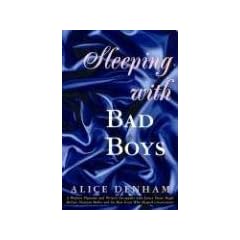
Her name is Alice Denham and she was all excited about her new book, whose full title is “Sleeping With Bad Boys: Literary New York in the 1950s and 1960s,” being reviewed in the New York Times. I looked her up and she’s been reviewed all over the place! She gave me a little flyer showing the front and back covers of the book. Back cover reads “Denham’s lusty memoir is a juicy tell-all about a time when male writers were gods and an aspiring and gorgeous female novelist tries to win respect… Caught between the sheets are James Dean, Norman Mailer, Philip Roth… The steam rises page by page as Denham — the only Playboy Playmate to have her fiction published in the same issue as her centerfold — chases her dream of writing as a young, oversexed beauty in the literary swirl of 1950s Greenwich Village…” The Denham I met seemed interesting, intelligent, quirky, and opinionated, as she rolled her eyes at some of our host’s jokes and wasn’t shy about yelling out, “that’s the ONLY funny one of the night” at the one that actually made her laugh (and she’s of course a lot older now than in her picture as shown above)… but she didn’t seem so ‘oversexed’ to me. I guess she read my thoughts because she said, “Oh, they sexed it up, you know,” rolling her eyes. “It’s really a feminist account of a woman in the 50s trying to be taken seriously as a writer.” Looks good, and I do think I’ll check it out. And Susan Brownmiller of “Our Bodies Our Selves” gave it a thumbs up!

One thing though: feminism and the whole (false) mind / body binarism has captured my interest of late, and Denham’s back cover made me think of it again. As dancers, our bodies are all important, and in a way, I guess we are our bodies. But we are also obviously intellectual beings. It’s just upsetting when someone — a man, doesn’t want to accept that, who thinks that because you’re a dancer he can treat you a certain way, disrespect you, say certain things, look at you a certain way — all things that can even be a bit threatening. I’m a lawyer, I’m not used to this. And it’s definitely not all men — definitely not even most; most men are totally cool; it’s just some who ruin it. Do a lot of female dancers get this treatment? What about “sexy” female writers like Denham? Or Candace Bushnell? Ann Liv Young said she got some suggestions about ways she could make her piece “sexier” by men who didn’t understand her work; she just rolled her eyes inwardly and thanked them. Very Dorothy Parker. I love her. Someone asked for Santoro’s phone number, I think she said as well. I wonder how Santoro reacted.

Anyway, on a more positive thought, regarding feminism: there are some really cool things going on in the city this weekend. There’s a “Global Feminisms” exhibit at the Brooklyn Museum on feminist art, and “Indwelling” — a combination of photography exhibits on women’s bodies by female artists, screenings of shorts films such as the movie “A Girl Like Me” which I saw at TriBeCa film festival and blogged about earlier — awesome awesome AWESOME short film by a high-schooler about young African-American girls’ self-perceptions — and some play readings such as The Vagina Monologues. The theme is women’s body images, and it celebrates the 25th Anniversary of the Women’s Therapy Centre Institute and takes place at Cooper Union’s Great Hall. Sounds excellent.

"The Virgin is a Lovely Number"


On Thursday night, I went to see Ann Liv Young‘s “Snow White” after seeing it posted on The Winger, by Gia Kourlas, who also has a good interview with the young iconoclastic choreographer in TONY. Very in-your-face, very rawly unabashedly unerotically naked, very hilariously WTF??, very post-post-post-feminist, and I LOVED it! This was my first time seeing anything by her, and I had to do some research, both on her work and the classic fairytale, to make a bit of sense (but I love that sort of thing — and I had no idea reinvention of the fairytale was so popular — in addition to Anne Sexton and Gregory Maguire, Angela Carter and A.S. Byatt have had their take). Young said it was based on the Grimm Brothers version and not Disney, which was pretty obvious, but I don’t think she needed to say that anyway: it’s really just her own thing entirely.

I’m not sure if I got what I was supposed to get out of it, or if there’s even some specific thing that she wanted me to get, but some themes I saw were pretense or illusion versus the real, tearing apart sex and gender stereotypes– rather lewdly too, subverting the (male, I guess) gaze, questioning the meaning of eroticism and nakedness versus nudity, etc.. It was kind of like a play within a play, but in a way that questioned what was performance and what was real. When the audience walked into the theater, the three performers were already standing onstage looking out at us waiting for us to take our seats. Young herself kind of glared out at us, a challenging look in her eye: she was not up there to please us, to show us prettiness and gratification. Similarly, at the end of the performance (which was rather abrupt), they just got up, took their things and walked off the stage, not waiting for or needing our applause, no bows, no “curtain calls.” And throughout the show, things would go wrong — sound devices that wouldn’t work, costume malfunctions, problematic props, etc. — and would be fixed onstage. It’s as if she’s questioning what a performance is, what are its confines, and at points, I wasn’t even completely sure if what was happening was supposed to be happening or if it was part of the show.

But back to the beginning. The three performers — one man (Michael Guerrero), two women (Liz Santoro and Young herself) — all wearing simple white ballet leotards and heavy black sneakers (the last of which is the only item of clothing that remains part of the costume throughout), play a rock song — Guerrero on drums, Santoro keyboards and Young singing. Each person, by the way, plays two characters — Guerrero the sound technician and The Queen, Santoro The Woodsman and The Prince, and Young the play’s director and Ms. White. After the song finished, all three stripped naked and changed into their next costume — all onstage. No strip-tease, nothing artful or sexy about it, just a clothing change done onstage — and therefore — really somewhat shocking. Certainly not Kenneth Clarke’s definition of “the nude.” Plus, none of the bodies are “idealized” — no makeup, no starving oneself for months on end or working out like a madperson for the idealized physique — these are real bodies.

For the next song, Young sings naked (except for the heavy black sneakers), while Guerrero works the sound and Santoro changes into her Prince costume — underwear with a giant strap-on dildo. The sound goes wrong, not enough is coming out of the mikes, and Young stops the performance mid-song to yell and scream at everyone for it. One male European blogger I read likened her to Eve Ensler, but to me, this ranting naked woman reminded me more of Karen Finley. Except, where Finley would often rant about overtly political issues, Young’s fist-pounding naked woman is political in another way: if traditional onstage female nudity (ie: for male gratification) must render (at least in fantasy) the woman vulnerable, humiliated, and subjugated to men in order for it to be titillating, Young’s dictating everyone around, forcing even the rather muscular man to run frantically about, his penis dangling between his legs, is nothing but amusing. She is hardly the vulnerable, submissive one, and is humiliating everyone else. Maybe the image is a bit shocking as well; I found it funny.

The Disney version has oft been criticized for reifying the virgin / whore dichotomy. As Sexton’s poem notes, the Queen is the sexed-up slut well deserving of her eventual demise, Snow the glorious good girl who is, for all intents and purposes a virgin — of course every woman must at some point perform those horrid ‘wifely duties’ but Snow’s “china-blue doll eyes … open to say Good Day Mama” but are “shut for the thrust of the unicorn…” Since she denies her sexuality, the fantasy of her virginity remains intact. Here, Young screws all such fantasies: the “Prince,” topless and with her giant strap-on dildo, climbs aboard Young, balancing his body over hers in a push-up, as if looking into the glass-box where the poor dead beautiful Snow lies. But instead of being a beautiful dead girl, Young is alive and active. She jumps up, pushes the Prince over, climbs atop him and straddles the dildo. Young told Kourlas part of what she wished to do was play with skepticism, so she wants the audience to see it penetrate her. The spectacle is rather outlandish and the audience kind of didn’t know how to react. Personally I don’t see how anyone could possibly find this ‘girl-on-girl action’ to be intended for male titilation — it seems way too vulgar — but Young told Kourlas that a European male viewer wrote to her that he thought the performance was quite sexy, but if she wanted to make it yet sexier she should lose the tennis shoes. In an earlier piece, entitled “Michael,” which I only read about and now wished I would have seen, apparently part of the action takes place in a trailer bearing three naked women dancing, and a male outside peering through the window, naked as well, and masturbating. He later comes inside the trailer, only to have his penis tied to the couch by the women, who pour soda over him while screaming, “I don’t love you anymore.” Is she saying that this is the fate that befalls the poor man who assumes women’s bodies exist solely for his gratification? Anyway, at one point during Snow White, Young reads to the audience some letters of criticism from former viewers, but she didn’t include this tennis shoe one and I wish she would have.

In the last section, the three performers pretend to be part of a radio talk show. One discussion revolves around how each character’s Valentine’s Day was spent. Young tells a story in which she was driving down the freeway topless, rocking out to cranked-up music and having herself a great time. A trucker sees her and begins following her. Of course, right then her tire goes flat. She throws a shirt on, jumps out of the car, and goes to the trunk to retrieve her spare, when the trucker stops and approaches her. He shoves her up against her trunk and pulls down his pants. Just then his black lab jumps out of the truck and attacks him, allowing her to run away. She flees into some bushes and hides, only to hear a shotgun go off. After the trucker pulls away, she goes back out to the street and holds the dog in her arms as he dies. A caller phones in and tells her if she’d just keep her clothes on her life would be much easier. Very disturbing, and Finley-esque.

Anyway, “Snow White” is playing at The Kitchen this Wednesday through Saturday. There’s tons of good stuff I left out. My friend, unfortunately, was disturbed by it, so I guess it may not be for everyone, but if you want to see a real spectacle that will likely challenge your notions of things and make you think, then just go and check it out for yourself.

Can (Or Should) Dance Have "(Political) Meaning"?

As with DEATH IN VENICE, I’m totally late in writing this (blasted briefs, annoying job!), but better late than never, right?… On Thursday night, Dea and I went out to BAM to see THREE ATMOSPHERIC STUDIES choreographed by American-expatriate-in-Germany, William Forsythe.

I’ve seen excerpts of Forsythe’s work before, but this was the first full-length piece I’ve seen by him, and I had no idea what to expect, but I absolutely LOVED it. Instead of pure dance, it was German ‘dance theater’ (“tanztheater”) so there was dialog, as well as acted-out or talked-about images, in addition to movement. There were three “studies” (ie: Acts). In the first, a woman comes out and tells the audience that the scene is going to be about the arrest of her son, and she points to the dancer, wearing a bright red shirt, who is portraying that character. Aside from that, the first scene consists entirely of dance, and, from there, becomes rather chaotic and remains so throughout. Dancers violently grab each other, hurl themselves at each other, jump on each other, throw each other, run from each other, fight, fear and comfort each other. It was honestly really amazing to me that no one got hurt. I also attended a pre-performance discussion at which Forsythe spoke a bit, and one audience member asked him if he considered whether his dancers would be injured and he assured us that dancers have a “very meticulous” sense of time and space. There was no music (apart from the dancers’ heavy breathing which acted as a kind of natural sound effect), so he must have been making a huge understatement! If someone was one millisecond of time or one milimeter off on floorspace, they or the person they were hurling themselves at at full force and lightening speed could have really got whacked. When I dance, I count my music by the beats; still baffles me how they all kept such exacting time with no music?…

At various points, the dancers momentarily freeze to make painting-like tableaux. It wasn’t until the second scene when the woman whose son had been arrested began speaking to a translator to tell her version of the events that I realized that, because there was so much violent commotion in the first scene and because I was so in awe of the amazing ways the dancers manipulated the floor and moved their bodies, I’d totally missed ‘the story’ of the arrest. Forsythe had said that one of the ideas he wanted to play with was our ability as an audience, both in the theaters of dance and of world affairs, “to pay attention”. I realized that I’d failed that test, and had no idea how the arrest happened, even after the woman had specifically pointed out to me what I was supposed to watch for!

So, in the second scene, the woman tries, unsuccessfully, to give her account to a translator so that she can make a police report. The language barriers, the fact that there simply are no words for certain concepts or objects (“you say ‘bird’, I can give you ‘airplane’ … for ‘castle’ how about ‘apartment building'”) is a metaphor for the severe limitations of language to connect people. At the same time that this dialog is happening, there’s a dancer in the middle, speaking and illustrating with movement, the content of several different photographs and paintings. Sometimes his words overtake the woman’s and the interpretor tries unsuccessfully to translate his descriptions of the images into words as well. There was a lot of confusion as to the meaning of this, but to me, it was a way of saying that we can be bombarded with so many images that, ironically, they ultimately prevent us from empathizing with the subjects depicted in them. Forsythe said another thing he wished to explore was “compassion fatigue” — how the multiplicity, and perhaps sensationalism, of images of others’ suffering exhausts our ability to feel compassion for them, and results in drowning out the truth depicted therein. So the image becomes more important than the reality. At the end of the second scene, the woman, interrupted by the dancer’s voice describing yet another “composition” cries out, in frustration, “which composition are we on now?”

The most powerful, disturbing part of that scene was toward the end, when the woman rises from her chair and moves around the stage, contorting and distorting both her body and voice in quite grotesque ways. That frightening distortion I thought graphically illustrated both her emotional devastation and the impossibility of her truth being told because of the distorting effects of images and language. Forsythe is known for exploring the relativity of truth. Perhaps he is saying pure movement is the best way of getting to truth?

I guess the last “study” is the most “political” if you want to call it that — at least in terms of it echoing a current, specific geopolitical situation. There has been a bombing and the woman, whose whole village has now been destroyed, is so devastated she can now hardly move. A man is struggling to hold her up. A dancer portraying a diplomat tries to console the woman, telling her (rather amusingly at times) the bombing has been for the good of the community, etc., and a dancer whom she (interestingly, the diplomat is played by a woman) points to as her assistant (also a woman) conveys the diplomat’s words through dance. The assistant’s body-distorting, somewhat grotesque movements, reminiscient of the woman’s in the second scene, evince the ludicrousness of the diplomat’s words and their powerlessness to explain, defend, or console.

I found that the combination of the dialog, images, and most importantly, the brilliant movement, made me think about all of those ideas that were explored — the relativity of truth and its vulnerability to reduction to false images, the effect of bombardment of images on the observer’s attention span and ability to connect to the subject, and the distorting effect of language. And I felt the theatrical combination of the three art forms was more powerful than one alone. Discussion of this piece has centered on whether dance can (or should) provide political commentary. But I’m unsure of the reasons for this focus. I think this ballet was ‘political’ in the sense that everything is political — the word comes from the word “polis” — the people, after all — so anything that has as its subject matter human beings, is to an extent ‘political.’ But I was compelled to think about the issues mentioned above, not that war is bad or the current situation in Iraq is the U.S.’s fault or something simplistic and obvious like that. In general, I think it’s far more productive to talk about the ideas presented by a work of art than whether they are political.

Anyway, today Ashley commented on Matt’s blog as well, posing some more interesting questions related to the Forsythe discussion underway there: what meaning professional dancers as opposed to audience members with little or no dance training extract from a ballet; whether non-dancers can understand pure movement in the same way pro dancers do; and, if non-dancers don’t comprehend pure movement, what then attracts them to the ballet — particularly the contemporary, story-less ballets and modern dance? I thought those queries were really intriguing, particularly in light of viewing this work. I, for one — someone with very little dance training — don’t “understand” pure movement at all, and don’t really try to either. The contemporary story-less ballets that I enjoy, I enjoy because I love watching the dancers move in amazingly beautiful ways. But then, the dancers have to be really really good. And, in fact, sometimes they have to be dancers with whom I’m already familiar. I don’t know if I would have loved “Clear” which ABT recently did, if David, Max, Angel, and Jared were not dancing it; I don’t know if I would have liked “Meadow” as much if it wasn’t Marcelo and Julie performing. I need to connect to the dancers, especially with story-less ballets (which is why I think books like “Round About the Ballet,” magazine interviews, and websites like the Winger are so important to promoting ballet and concert dance).

I think a lot of dance fans also go to the ballet for the sensual experience: they perhaps enjoy Balanchine, for example, because they savor the feminine beauty, the pretty, dulcet charm of his ballets. I prefer ABT’s celebration of masculine (including both male and female) beauty and strength exuded by the ballets they present. I think people often go for the sensations the experience, the way the ballets make them feel, rather than to make them think. But then, for me, Forsythe is a welcome change to all that, at least once in a while. I think I’ve been seeing so much contemporary ballet of the “Clear” and “Meadow” variety during ABT’s recent City Center season, I was quite starved for more — to be given a chance to use my mind, to be compelled to decipher meaning, at points rather complex. That’s me, anyway. Very interesting to ponder just what it is that draws non-dancers who presumably derive no solid ‘meaning’ from pure movement to concert dance though…

Crap Friday, Sobering Saturday…

Ugh, horrible night last night at the studio. First, the second I exited the subway and saw what I saw, I had to ask myself why, why, why do I have to go to a studio located in the Times Square area??? And, if I must go to a studio located in this madhouse, why did I not remember to cancel my two-days-before-the-ball-drops lesson???

Times Square two days before New Years Eve

Needless to say, it took me twenty minutes to get from 42nd Street all the way up to 44th, two whole blocks… Why do tourists want to visit at this time of year??? Maybe I should listen to myself and go to Rio some time other than Carnival… Hmmm..

Anyway, then the lesson. I just couldn’t understand anything Jacob was saying, and he was being really rather impatient. We practiced my kick splits in the air — where he gives me his arm and I push down and propel myself up about three feet, do the splits as quickly as I can, pointing my toes of course, then come down about 1/10th of a second later. So much harder than it seems to split, straighten legs and make the perfect line, point toes, then come down right away, and remember to do so on bent knees, bent ever so slightly — not so much so that the audience can actually TELL they’re bent, but bent enough so that you don’t kill your knees coming down on straight ones, and in HEELS… Ugh. We did it about twenty-five times. I was finally getting the hang of it, when he wanted to start on these crazy stretches, where I lean away from him as far as I can but while holding his hand. Apparently, I’m supposed to kind of give him my body weight, but kind of hold my own weight — which I don’t get AT ALL. Pasha always used to tell me, “you have to hold yourself; you’re responsible for your own weight, not me,” and sometimes he would even let go ever so quickly to see if I’d begin to fall. Of course I always would, scaring the crap out of me, and making me hold myself completely up giving the man NONE of my weight now. Now Jacob is telling me, “you’ve got to trust me and give me your weight; you’re not trusting me, and it’s not going to look right if you don’t lean completely away me so much so that you’ll fall if I let go.” What? I swear it’s the antithesis of what Pasha said, but he said it was not, and tried to explain how to both hold myself AND trust the guy and give him my full weight, but I didn’t really get it. I guess as time goes on, I will. Hopefully.

And then apparently I am doing too many ballet-like things because he kept telling me, “no releve, this isn’t ballet,” “no ballet hands,” ” no ballet develope; in ballroom we bend the standing leg,” no ballet this, and no ballet that, and so on. Funny thing is, it’s not like I’m a former ballet dancer. I only have childhood lessons taken long long ago, and as an adult, I’m only in basic ballet classes. So, I couldn’t understand most of the terms he was saying, and therefore couldn’t really understand what exactly I was doing that was too ballet. I mean, I go to bizillions of ballet performances, obviously, but can that really rub off in terms of your own dancing? I want to push myself as far as I possibly can, and learn as much as I can as quickly as I am able to, but I just wish so much I had more background so that I would know terms and different dance techniques and be able to differentiate between different styles of dance…

Then, bright and early this morning (sorry, this is total whiner blog today…), my mom called telling me my dad was all upset because apparently he watched the DVD of my most recent studio showcase that I sent him as a Christmas present and couldn’t find either of my routines on it. “Are they on your copy?” she asked. And, if so, can you point to him exactly where? Blech! Of course, I hadn’t yet watched the copy of the tape I kept for myself, because I just hadn’t yet worked up the courage to do so (there’s nothing I HATE more than watching myself dance!). I told her to hold on, popped the blasted thing into the machine, confirmed they were both there while nearly throwing up in digust over my hideous lines, total lack of rhythm, missed steps, horrible gorilla arms, enormous, elephantine hands, etc. etc. etc. I nearly forgot she was still on the damn line. When she later called me back after reporting back to my dad, I found that he actually saw the whole tape and just didn’t recognize me. Lovely feeling when your own parent doesn’t recognize you!!!!!

Anyway, in an attempt to overcome my self-disgust, I marched straight out to my local bakery, and got this perfect early morning meal — chocolate fudge cake and Hazelnut coffee with about four scoops of sugar; a.k.a. the breakfast of pigs:

chocolate cake for stress attack breakfast

And, as soon as the liquor store opened,

Spent the afternoon by turns in front of the TV hysterically watching my hideous performances, then in front of the mirror, trying to do the lines Jacob was trying to teach me. Ugh. It just wasn’t going anywhere. Finally decided to just give it a break, and plopped down in front of the computer to read blogs. Serendipitously found these lovely little words of wisdom from Matt — thanks Matt!

When I got bored of blogs, I decided to go visit my local Barnes & Noble, to use the gift card my mom sent me as part of her Christmas present. Came away with these wonderful finds:

Pynchon, Powell, and Dance Mag

Thomas Pynchon‘s new book “Against the Day” is so damn huge (nearly 1100 pages), I don’t even think it’s going to fit in my dance bag (with all the other stuff I have to put in there, I mean), which means I’m gonna have a hard time carting it to and from work on the subway… Well, maybe it’s a better read for home anyway; looks pretty dense. I’m very excited though! This is a first edition by a future Nobel Prize winner after all 🙂 It’s a real investment — both in terms of the material my brain will absorb, and the item itself; am kind of surprised more people aren’t buying them all up…
Also, upon noticing it in the new paperbacks section, I couldn’t help picking up Julie Powell’s chick lit book that evolved from her blog (this is the woman I’d met a couple of weeks ago at the “Bloggers into Authors” panel discussion held by Media Bistro). And, couldn’t resist Dance Magazine which advertised on its cover this article inside entitled “Talking Back to the Ballet Bashers” presumably on the recent Lewis Segal criticism everyone was talking about for a while, which I couldn’t miss…

And then, came home and am blogging while watching

Ford funeral on TV

the Gerald Ford funeral. So sad; I feel so badly for his wife… And then, the Hussein execution is of course all over the news. And I have such conflicted feelings. I just don’t think anyone should be put to death for anything…

So, a sobering but less stressful end to a crazy, self-absorbed day… I do think I’m going to leave dance alone for the rest of the weekend. I’ll go back to hystericizing after the holiday! I need a break :/

Happy New Year everyone!

Governor Spitzer!


So, we have a new Democratic governor. Does this mean, someday in the not too distant future, the Appellate courts will become a little more friendly to we appellate Public Defenders?! Does it mean there will be a slightly greater than 1% reversal rate in criminal convictions?! Does it mean the state death penalty will be revoked (not that it’s been used since being reinstated, but one never knows what more conservative D.A.s might do), and there will be more drug sentencing reforms? I guess it’ll take him a while, especially with the judicial appointments… Still, happy happy day all around!!!

Above pic is a view from my couch, where my butt was firmly planted for several hours last night. This is obviously our senator-re-elect… Or… is it the next U.S. President?!

I can’t believe it’s been six years since that chaotic insanity took place. Wow. And now, with the Montana and Virginia Senate races undecided, we could be in for a repeat of that lovely ordeal. Less flashy repeat, but seeing as how Congress has more power than the President, no less important…

ABT Fix Is Gone Gone Gone … What’s A Girl To Do?


ABT‘s fall City Center season ended yesterday, sadly. Above is the cast of Glow-Stop, with the ever-radiant David Hallberg in the middle, from this past Saturday’s matinee performance. I love the mixed repertoire that my favorite dance company performs during their fall season so much better than the full-length classical ballets they do at the Met in the summer. I generally like contemporary ballets better than classical because I find it fun and challenging to try to decipher the choreographer’s meaning, plus I get a little bored seeing the same classics over and over again, and who doesn’t like something new! And, I get to see a lot more of the corps dancers who are mainly relegated to the background in the classical ballets (most of which offer only a couple of large roles per ballet, given to principals and soloists). So, it’ll be another year til I see my favorites in my preferred season again, ho hum.

Anyway, highlights for me were:

1) Marcelo Gomes doing Sinatra in Tharp’s Sinatra Suites, Marcelo dancing the part of the cocky macho sailor in Robbins’s Fancy Free, and Marcelo and Julie Kent making that insane-looking never-ending lift in Lar Lubovitch’s Meadow look completely effortless. Marcelo has such a huge personality, larger-than-life stage presence, great acting ability, and sincere appreciation for American culture, that he brings so much more than the others to the Tharp and Robbins roles. If he was not a ballet dancer, I think he would be a very successful actor!

2) David Hallberg in everything I saw him dance — Clear, In The Upper Room, Drink to Me Only With Thine Eyes, Afternoon of a Faun … and he was definitely brilliant, expectedly, as Death in Kurt Jooss’ both timeless and timely, Post-WWI antiwar piece, The Green Table. He is such a beautiful man; his dancing is like watching poetry in motion. With his height and long limbs, he just fills up the entire stage whenever he is on it and makes spectacular lines. And his luminous, wispy blonde hair accentuates the fluidity of his movement. He is, I think, the quintessential lyrical dancer, and has definitely become, along with Marcelo and Jose Carreno, one of my favorites: David is the most sublime, Marcelo has the most endearing personality, and Jose is, quite simply, the greatest dancer in the world right now 🙂

(P.S.: David hasn’t been writing so much on The Winger this season, but, from what I’ve seen at City Center, that is likely because he’s been dancing every single night, so we’ll forgive him for momentarily neglecting us Wingers 🙂 )

3) Other principals I enjoyed were: Jose (like always) was perfect in everything he did; Angel Corella was wondrous in Clear, Max Beloserkovsy was beautiful dancing alongside David in Clear, Irina Dvorovenko was dazzling dancing Tharp, as she always is (and, as I think I’ve said before, to me, is currently the quintessential Tharp ballerina); Julie and Gillian were powerhouses in Meadow maintaining those shapes in mid-air practically on their own, supported only by what, Marcelo’s pinkies???

4) And a lot of the corps members I haven’t seen much of before: Misty Copeland stood out (at the beginning of the season, before she was injured anyway); both women who performed the Sinatra Suites — Sarah Lane acted the part very well and was so sweet receiving her many bouquets during curtain call the night she danced it with Angel 🙂 , and Luciana Paris had absolutely gorgeous extensions; Craig Salstein was a blast in Fancy Free and Rodeo; Jared Matthews is so damn cute you just want to pick him up and squeeze him!; Isaac Stappas did Death just as well as David I thought; Blaine Hoven seemed to be in just about everything and was very strong; Kristi Boone was remarkable in Glow-Stop; Marian Butler rocked in Rodeo, and Yuriko Kajiya was so sweet in Upper Room … and that’s just a few off the top of my head…

On a completely different note, one final thought about what we all had damn well better be doing at some point tomorrow, said much more compellingly and humorously by my very favorite political blogger. Please click here to read her raucous mad fun words of infinite wisdom.